Open Access

These posts are viewable by all visitors to the site, and always will be. Was previously “Blogs and Essays”.

Rangzen: The Movement for a Free Tibet and a Call for a Decolonial Movement Dharma

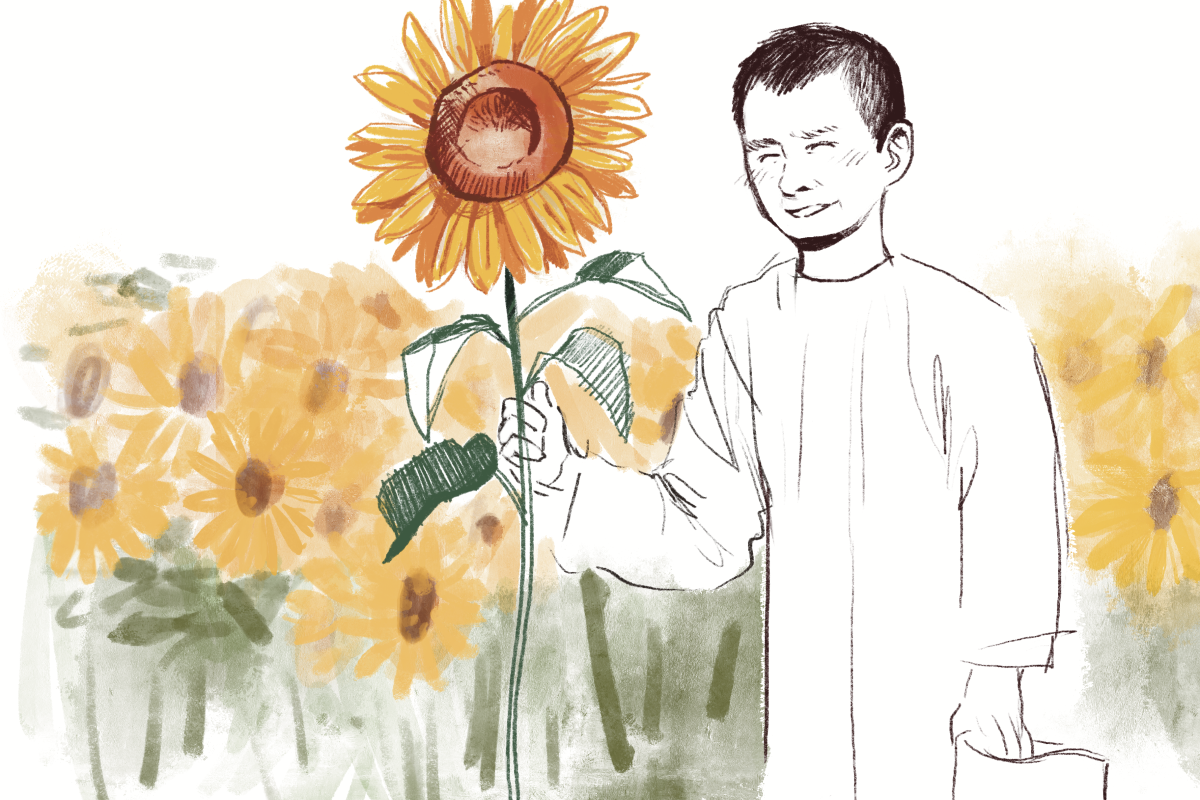
Editor’s Note The following interview with Tenzin (Tendor) Dorjee, Director of Research and Advocacy at Tibet Action Institute, and former director of Students for a Free Tibet, took place over thali and momos in Jackson Heights, Queens. It has been lightly edited for clarity and flow. I was eager to speak with a leader of Rangzen—the Tibetan Freedom movement—about Buddhist movements for liberation and the perceived support for this movement among contemporary Buddhist practitioners in North America. In the spirit of this special issue on Movement Dharma, which aims to (re)awaken political consciousness and engagement among Buddhist practitioners, it felt necessary not only to center indigenous decolonial movements, but also to honor the lineage and culture of Tibetan Buddhism, from and through which so many of us practice and have received teachings. Tendor and I met shortly after the self-immolation of Tibetan activist, Logba Rangzen. In protest of China’s ongoing occupation and cultural genocide of Tibet, Logba Rangzen self-immolated in front of the United Nations on July 2, 2026, the day after China announced its …

Navayāna Buddhist Ministry: Dr. Ambedkar’s Dhamma and the Making of a Buddhist Movement Chaplaincy for Social Democracy and Liberation

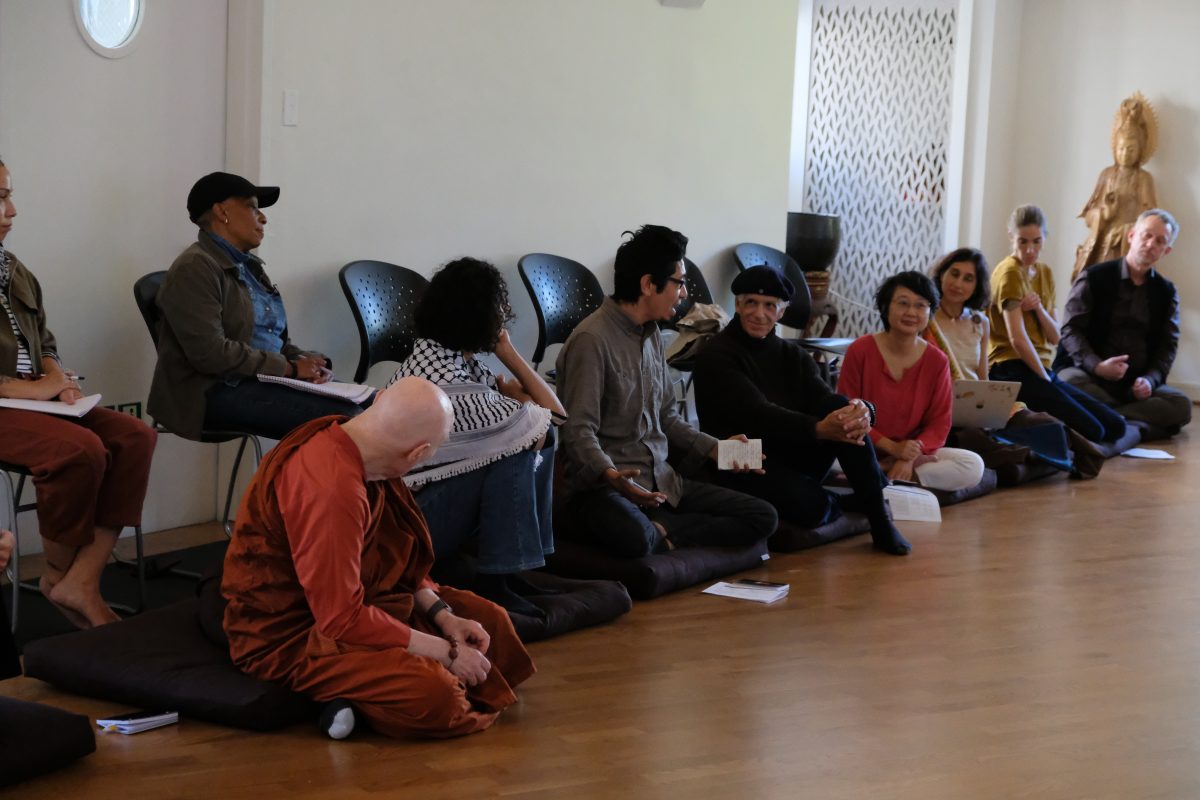
We are in urgent need of spiritual leadership equal to the interlocking social, economic, political, and ecological crises of our time – crises that are, at their root, relational and dualistic, born of the many ways human beings have learned to treat one another as separate, as ranked, as disposable. Nearly seventy years before this call was written, Dr. B. R. Ambedkar arrived at strikingly similar terms for a comparably total crisis. In 1956, nearly a decade after Indian Independence, Ambedkar embraced Buddhism, an act that opened a new window through which to view Indian history, particularly for the lower castes and all those who had long suffered under the hierarchies of the caste system. The process of building a new India had already set in motion a range of competing ideological visions, each seeking to reconstruct a national culture capable of honouring both the proud heritage of the ancient past and the egalitarian promises of the modern future. This search drew many creative thinkers toward a progressive and experimental modernism in art and culture, …

Hart Island

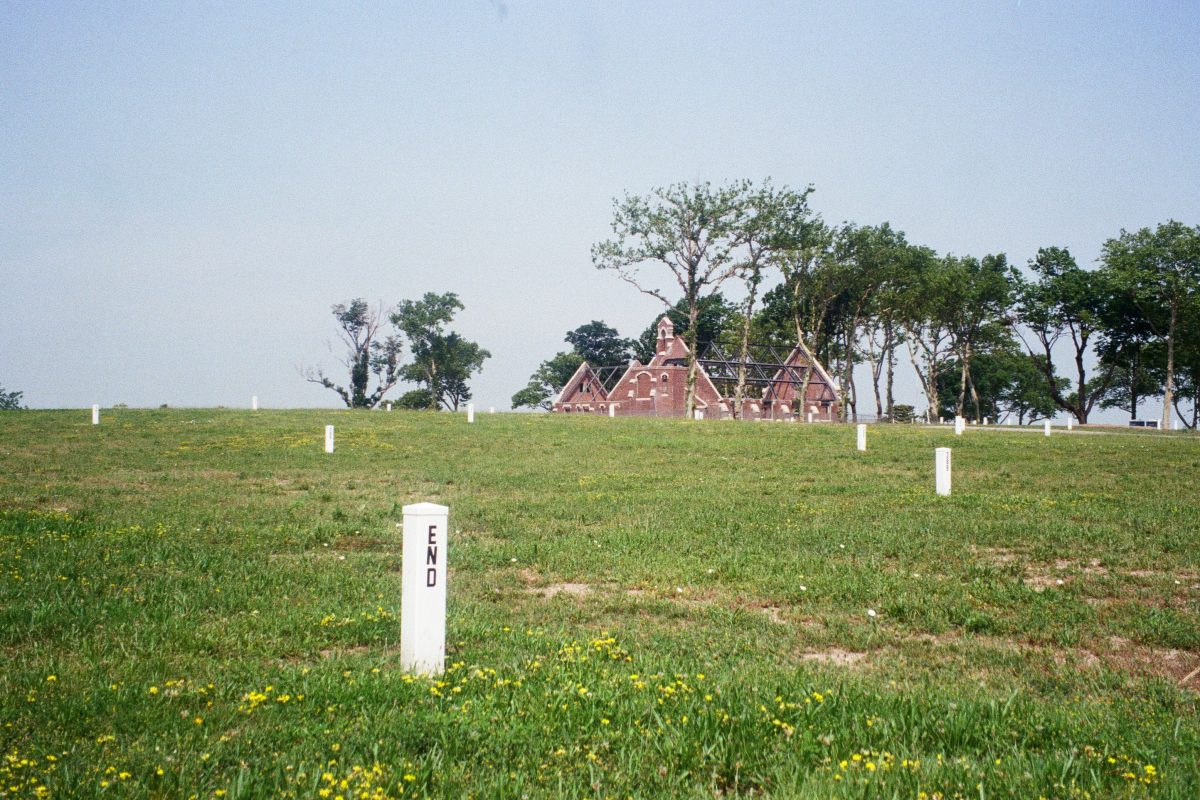
“Then Judas, who had betrayed Him, saw that he was condemned, repented himself, and brought again the thirty pieces of silver to the chief priests … and they took counsel, and bought with them the potters field to bury strangers in.” – Gospel of St. Matthew (27:3-8)   When a spirit, a mindstream, a bundle of karmic tendencies slips from the body like a tight shoe, or–for the materialists–when the life force of an organism is stamped out by the natural laws of death, its once-animated form is left behind. What will come of this form?  From the beginning, homosapiens have devised an abundance of ways to deal with our dead. We bury them (in the ground, at sea, in caverns), burn them, entomb them (the Great Pyramid!), compost them (green burials), and ceremonially dismember them on high mountain plateaus where carrion eaters have received human corpse offerings for generations (look up Tibetan sky burial for more on that one).  But what of the dead who, in the cold atomization of modernity, die alone, unclaimed, …

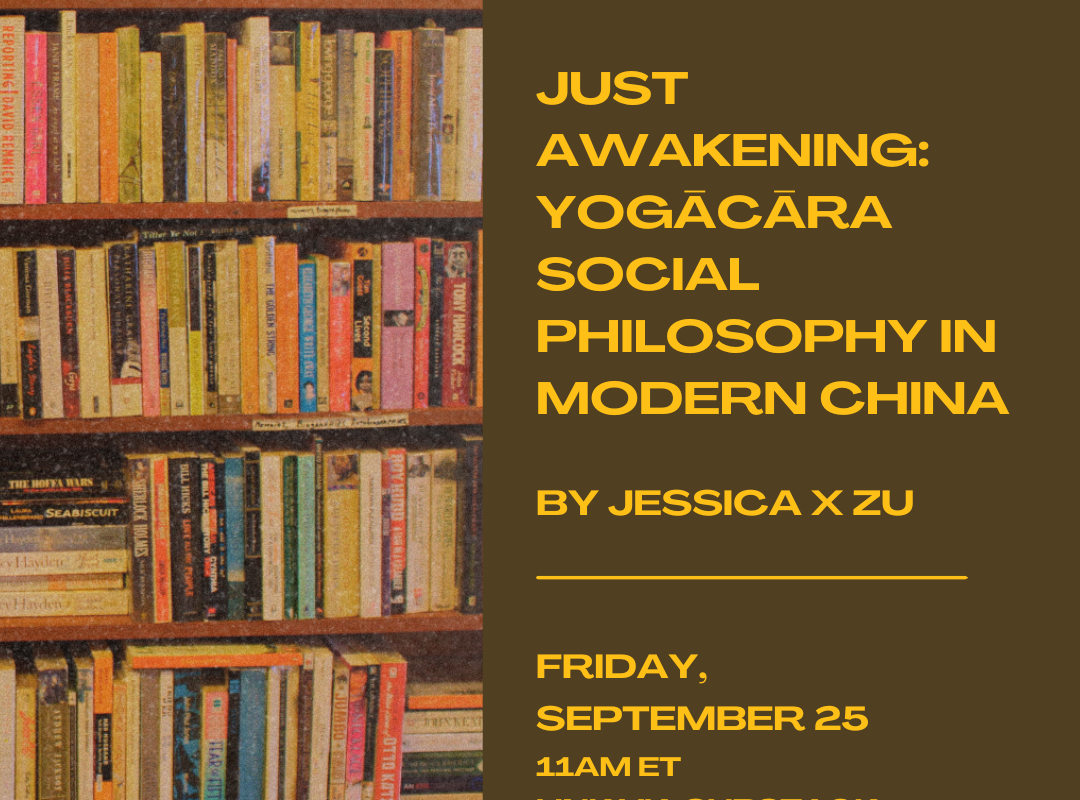
Author Interview: Just Awakening: Yogācāra Social Philosophy in Modern China by Jessica X. Zu

Just Awakening: Yogācāra Social Philosophy in Modern China, by Jessica X. Zu, is a work of “liberation Buddhology” that explores how early 20th-century Chinese intellectuals drew upon Yogācāra philosophy to build an irresistible, revolutionary activist movement to bring forth a nonviolent, just society. The book, which just won the prestigious Toshihide Numata Book Award in Buddhism, offers a compellingly clear account of what Zu terms “socio-soteriology”, a new revolutionary project of social philosophy and praxis.  The following interview is from our forthcoming special issue, “Movement Dharma: Towards a Buddhist Movement Chaplaincy.”   Brooke: I was tremendously excited to talk with you about your book, Jessica, and to introduce our Arrow readers to this outstanding text. As a community, we’ve been engaging deeply with concerns around collective liberation and themes of pluriversality, and the question of how to build more loving, just, relational, and non-dominating communities and societies. Your book offers us a path forward, and it also speaks directly to the heart of this special issue, “Movement Dharma,” and its concerns with what the dharma …

The End of ‘The World’: Contemplation and the Decolonisation of the Self

written by Peter Doran A Terminal Paradox At the ‘end of the world’ as constructed in the image of the West we’ll discover a terminal paradox: the prospect of a new ethics of flourishing—both human and ecological—as we discover new forms of liberation in an encounter with limits. There is no transformation or transition available in mere sacrifice or limitations that do not also imply an overturning of the container [‘the box’] that sustains the language and concepts of colonial modernity. The transformation or transition must entail an individual and collective preparedness to drop investments in the prevailing language games and the violent structures that sustain the unsustainable. In Zen, the encounter with limits and forms is a mark of liberation: at the heart of practice is a discipline that also entails a radical break with our deep investments and identifications with concepts and language games; not with a view to abandoning the world but with a view to falling into an unbridled love and compassion for all with whom we participate in our timeless …

Like Water: Practices for Maneuvering with Strength, Suppleness, and Clarity

“Water is fluid, soft, and yielding. But water will wear away rock, which is rigid and cannot yield. As a rule, whatever is fluid, soft, and yielding will overcome whatever is rigid and hard. This is another paradox: what is soft is strong.” – Lao Tzu   This special issue of The Arrow Journal came together around a core question: how do we navigate turbulent waters with clarity, strength, and suppleness? The articles, essays, poetry, and art contained within offer our readers diverse teachings on water through various streams of inquiry. This special issue is also complemented by a seminar and podcast series featuring martial artists, nondual spiritual practitioners, and movement leaders including Cynthia Ong, Paloma Schultz, Reverent Greg Snyder, and Autumn Brown beginning April 7, 2026. We hope you will join us! Issue Contents Chief Editor’s Introduction  Brooke D. Lavelle Doing “Nothing” as Ecological Practice Derek Gladwin and Naoko Ellis The Way of Water, the Way of (re)Existence: Embodied Contemplations on Grief, Precarity, and the Power of Transmutations Megan M. Fowler Something Worth Defending …

Doing “Nothing” as Ecological Practice

Sit and Do Nothing for the Planet In today’s highly polarized world, it is likely no secret that conversations about the environment have become political flashpoints—an urgent priority for some, aggressively resisted by others. This divide stifles meaningful dialogue and action, often trapping us in demoralizing cycles of manufactured conflict while the planet, and all life on it, continue to suffer.  More and more people are asking, “what can I actually do about climate change?” Others find themselves worrying that “it never feels like I’m doing enough to make a difference.” We, too, as environmental educators and researchers, can relate and empathize with this. We have spent years observing and reflecting, and then asking:  How do we teach and learn in an unraveling world? How do we live in these interconnected systems? How can we adapt, not just to climate change, but to epistemic changes, embracing multiple ways of knowing and learning?  After all, learning is much more than just accumulating facts or information. What we (the authors) have unlearned, with the need to reconsider …

Courage is a Reverberation

At a recent gathering, a person voiced this question: “How do I grow courage? It seems like we’re gonna need to grow courage right now.” To which I replied: “Well, it won’t happen by thought or belief. Embodiment counts. And embodiment requires physical practice.” At that point, I was stuck. Here we were in a hotel ballroom. Answer given; answer useless. Without the accompanying physical experience, there would be no possibility of understanding what embodiment means, let alone its pathway to growing courage. A speaker has latitude, and I used it. Inviting folx for a sample of a practice, warning that shouting would be required. It is a sign of the times that most folx in the room accepted the invitation to stand and shout, in a very specific way. Feet hip width apart, with more weight on the balls of the feet. Standing tall, with dignity, eyes on the horizon. Relaxing shoulders, releasing all unnecessary tension. Arms to the side and bringing the breath low and slow. Low in the body, slow in breath, …

The Normalization of Terror: A Buddhist Response to ICE’s Extrajudicial Tactics

How we lose our democracy one arrest at a time I live in New York City, where the streets have become laboratories for state violence. Here in October, on Canal Street in Chinatown, masked federal agents descended in military-style trucks to arrest street vendors selling knockoff handbags. Four U.S. citizens were arrested and held for nearly 24 hours without charges, their families filing missing persons reports before they were released. Acting ICE Director Todd Lyons announced that New York City would see “an increase in ICE arrests,” promising operations that were “intelligence driven” and “not random,” even as bystanders watched agents use batons and pepper spray on vendors and protesters alike. The Canal Street raid was not an aberration. In early June, ICE’s New York office arrested more than 110 people on each of two consecutive days—the highest single-day totals in nearly two years. Agents have been staking out immigration courthouses, arresting people attending regular hearings in hallways, lobbies, and even bathrooms. The scenes are surreal: federal agents in tactical gear blocking streets, protesters tackled …

Crapitalism: Psychoanalysis and the Profit Motive

As the old proverb goes, “It’s an ill bird that fouls its own nest.” From a god’s eye view, we’re pretty sick birds, spewing massive amounts of carbon into our atmosphere and dumping an endless stream of plastics into our oceans. Why is that? On first glance, the answer is obvious. We have an economic system organized around the endless pursuit of more, excess known technically as the profit motive. Always seeking more on a finite planet was never going to end well.  Given the profit motive’s centrality to global capitalism, it’s curious how rarely we discuss the motivations behind it. Interestingly, Karl Marx—the great critic of capitalism—didn’t have much to say about greed. For Marx, greed was an ugly human impulse that predated capitalism. The system, however, incentivized the impulse, throwing it out of proportion with our other drives. Change the system, and the problem falls away. This might be true, but the greed and corruption that helped sink many socialist regimes are cause for pause. Understanding the deeper motives behind the “more” motive …

Steadfastness & Solidarity Through Genocide: SWANA & Ally Voices

This issue “Steadfastness & Solidarity Through Genocide: SWANA & Ally Voices” (Volume 11, Number 1) is now open access for all given its critical and timely nature. Guest Editor, Kareem Ghandour writes, “Through a year of live-streamed genocide, the world has become witness to the power of sumood. The world has been shaken not only by the violence inflicted on the Palestinian people, but by the indigenous spirit of Palestinian resistance. Sumood has become more recognized as an expression of sacred activism and a lived experience of spiritual resistance rooted in love, community, culture, and unshakeable connection to land… In these pages are different expressions of Sumood, shared through stories, conversations, historical accounts, poetry, and spiritual teachings. This issue also makes space for the emergence of a radical spiritual pathway, opening us to the ways that Gaza is liberating us and generously offering us spiritual teachings born from a ground of unimaginable horror and destruction. These teachings on steadfastness, faith, and collective healing offer us guidance on how to continue resisting and meeting these times …

A young Thich Nhat Hanh Illustration by Rae Minji Lee

In the Symphony of the Storm: Four Phases of Engaged Buddhism in Thich Nhat Hanh’s Life

This essay appears in the issue “Engaged Buddhism: Honoring Thich Nhat Hanh’s Life and Teachings (1926-2022)” (Volume 10, Number 1). Click here to subscribe and download the entire issue.  Subscribe to The Arrow Journal to read the complete issue, plus unlimited access to the only journal dedicated to investigating the meeting of contemplative wisdom and the systemic challenges facing our world. Already subscribed? Read the issue: Engaged Buddhism: Honoring Thich Nhat Hanh’s Life and Teachings (1926-2022) | Vol. 10, No. 1 | Spring 2023

There is a Love Beyond Hope

In my decades working on environmental problems and social change, I was motivated by the hope that humanity would change everything in time to slow climate change and transition to a sustainable way of life. I even talked of it that way, without looking more closely at that idea of “hope.” What did I mean by that? Could I be motivated without such a hope? In my rush to achieve an impact in the world, I did not take the time to explore our shared cultural story about hope, despite being a part-time academic, where deeper inquiry is often expected. Eventually, evidence from the real world forced me to think again about hope and to ultimately free myself to live creatively in the face of societal disruption and collapse.1 I discovered there is a love beyond hope, a love which can guide active engagement in society without attachment to outcomes. Through that engagement, I met many people attempting to reduce harm and contribute to possibilities within our environmental predicament without ‘fairytales’ of success required to …

Undisciplined Archives: Dreaming Across Black Geographies

  Issue Contents Journal Editor’s Introduction: An Antidote and A Map: Narrative Cartographies for Black Dreamers shah noor hussein, Managing Editor Guest Editor’s Introduction: We Were Dreamt: Reflections on Black Dreaming as a Liberatory Practice Naya Jones Sleeping in Kwame’s Room: Crocodile Dreams of Freedom from a Summer Return to Kumasi Anthony Kwame Harrison In this genre-defying piece—positioned somewhere between personal essay, family biography, and historical research paper—I reflect on my first time returning to my city of birth, Kumasi, Ghana (the capital of Ashanti) in summer 1995. For one magical summer, I stayed with Peggy Appiah, a dear family friend and the mother of my namesake. A series of dreams I had while in Ghana frame a wandering circuitous account of my experiences with people, animals, and place. Key themes surround: Ghanaian Independence in the context of Pan-Africanism; the meaning of dreams in the Akan/Ashanti world(view); family, home, and allegiance both within and outside of Ashanti society; and the capacity of proverbs, stories, and, above all else, dreams to animate new modes of freedom …

Nurturing a Relational Mindset

This essay first appeared in Insights: Journey into the Heart of Contemplative Science and is reproduced with permission from the Mind & Life Institute. When I was a junior in college, I signed up for a course on meditation and developmental psychology. On the first day of class, the professor asked each student to write on a notecard, “the voice in your head that you wish you didn’t have to listen to throughout the day.” I felt apprehensive. I didn’t know my classmates, and everyone appeared put together, attractive, confident, and more at ease than I felt. We privately wrote on our cards, turned them in, and a few moments later, the professor read aloud our statements: “You are not worthy to be loved.” “You will never amount to anything.” “It’s only going to get worse.” My perception of myself and my classmates instantly changed—from skepticism and distance to care and solidarity. In that moment, I saw myself and the other students in a new light. We were united by an invisible thread of internalized …

Kushil Gunasekera in front of his foundation on the anniversary of the 2004 Tsunami. Photo credit: Reuters.

“The more you give, the more will be yours to give”: The Karmic Philanthropy of Kushil Gunasekera

“I want to be one of the nicest human beings that this earth has seen,” Sri Lankan Buddhist philanthropist Kushil Gunasekera told me in an interview early in 2020. I’ve known Kushil for years, so I’m no longer surprised when he makes such bold pronouncements about his life goals. From the naming of his humanitarian organization as the Foundation of Goodness, to its organizational mission of promoting “unconditional compassion,” bold claims of moral excellence are fundamental to Kushil’s understanding of himself as a Buddhist humanitarian. At first glance, Kushil’s ambition to be one of the nicest human beings may seem overzealous or even audacious. Yet, such a gloss would overlook Kushil’s passionate and earnest desire to cultivate and perfect his spiritual vocation of generosity. Take for instance the time when, facing severe personal financial duress, Kushil used the last remaining credit on his credit card to pay the college fees for three children of a woman he hardly knew. Facing financial bankruptcy, he had mortgaged his home for a personal loan. He was not deriving …

Baldwin and Buddhism: Death Denial, White Supremacy, and the Promise of Racial Justice

“Terror cannot be remembered… Yet, what the memory repudiates controls the human being. What one does not remember dictates who one loves or fails to love.” —James Baldwin More attention should be paid to why white people remain so attached to narratives of racial supremacy. This was a sentiment shared by authors Rev. angel Kyodo williams and Resmaa Menakem in an online fireside chat held in the wake of Jacob Blake’s shooting in Kenosha, Wisconsin.1 If the purpose of radical analysis is to grasp injustices at their roots, then what might lie at the aching roots of white supremacy? Menakem’s provocative answer, in his excellent book My Grandmother’s Hands: Racialized Trauma and the Pathway to Mending Our Hearts and Bodies, is that white supremacy is conditioned by generations of unprocessed trauma: “White bodies traumatized each other in Europe for centuries before they encountered Black and red bodies.”2 Left unprocessed, that trauma has helped fuel a will to racial supremacy that works emotionally to soothe people whose violent histories made them feel less-than. A question that …

Artwork by Rae Minji Lee, with photography by Carolina Marinati (CC0)

Spirituality and Survival: Imaginative Freedoms for Abolition Futures

In this collection on “Spirituality and Survival: Imaginative Freedoms for Abolition Futures,” authors engage key questions of Black survival in this moment: How are Black communities activating our ancestral knowledge to cultivate a future we are willing to fight for and worlds in which we want to survive? We invited authors to consider the following questions in their writing: How are you showing up right now to take care of yourself and to care for others? How are you showing up in mindful solidarity with the movements confronting police violence and demanding abolition? What contemplative insights, spiritual wisdoms, or dharmic teachings are you finding most relevant for society or for you, personally, in this time? How have Black histories of protest, riots, and revolutions related to spirituality? How have our ancestors, both familial lineages and intellectual inspirations, responded to past turmoils with insight and vision across the diaspora? How can the changes we need, including the abolition of prisons and police, be spiritually guided, mindfully motivated, and creatively conjured now and tomorrow? How can these …

Land-Based Ethics and Settler Solidarity in a Time of Corona and Revolution

Settler colonialism has been defined as a structure, not an event, meaning that settler societies like the U.S., Canada, and Australia endure over time through racist laws and ideologies that naturalize the dispossession of Indigenous populations.1 One of the most effective strategies that settler states rely on to eliminate Indigenous peoples and their power is the idea that their knowledges are primitive and superstitious, examples of failed epistemology.2 This view is rooted in an Enlightenment-born materialism that asserts that legitimate knowledge can only be produced through narrow empirical methods, relegating the negotiations of immaterial life to the social margins.3 As the colonial project progresses, legitimate knowledge production is simultaneously tethered to race and power (reserved to the white and landed), resulting in what we have come to know as modernity.4 Settler colonialism seeks to eliminate Indigenous populations in order to monopolize resources for the sake of capital. It operates through laws and racist ideologies, but also through conceptualizations of the natural world as white men’s for the human taking. Settler colonialism operates from its own …

Illustration by K.T. Tierney

Practice, Resilience, and Compassion in the Time of COVID-19

In this collection on the COVID-19 pandemic, authors share reflections on the personal and political in this time of global uncertainty and suffering. We invited authors to consider the following questions in their writing: How are you showing up for the pandemic? What are you doing to practice calm and clarity? How are you staying grounded in the midst of groundlessness and sudden shifts in routine? How can we negotiate safety and mutual aid? How can we practice compassion and helping others at this time? How do we make sense of this monumental crisis? How are you relating to ways the pandemic’s effects are mapping onto the injustices and inequities of our society? Their responses, which we will publish successively in the coming days, speak to personal experience and social calamity, to profound injustice and the possibility of something else. Check back here or follow The Arrow on social media as we publish new pieces. Contents Finding Ground, Making Sense, and Getting Simple by Kelsey Blackwell Facing Pandemic, Finding Ground by David Kahane Toilet Paper as …

Going to the Root: How White Caucuses Contribute to Racial Justice

Caucusing is a form of upāya—skillful means. To caucus is skillful because it reduces harm. For Buddhists, practicing harm reduction is a relative bodhicitta practice. In my experience of 24 years of facilitating racial justice work, I have found that it is not helpful to put together in the same room folks who have had racism aimed at them all their lives and folks who haven’t had to think about it very much, if at all. The latter group, white people, need a place to start thinking and feeling about it, a space for using prajña (insight) to discover how white conditioning, through no choice of their own, has been embedded in their ego. There is no white person in North America who does not have white conditioning.1 —Robert Horton, Co-FounderThe UNtraining: Healing Personal & Social Oppressions The current political landscape of the United States has made it impossible for us to avoid our racial karma. In recent years, the news has been littered with it: police violence and murder of Black and brown people …

Leaf on water, book cover
Cover Image for Healing Justice: Holistic Self-Care for Change Makers

Healing Justice for a World on Fire

In the Adittapariyaya Sutta, known as the Fire Sermon, the Buddha says that everything is burning—burning with the fire of greed, hatred, delusion, sorrows, griefs, lamentations, pains, and despair.1 But what does it mean not only to survive this burning but to live a more liberated life in a world that is on fire? While dutifully cultivating mind and spirit through practice and retreats has seemed like what would be most fruitful in “my” awakening, this approach has in fact left too many stones unturned. My personal blind spots, as well as the suffering I witness and am co-conspirator in creating on this planet, need more careful attention and action. My liberation is tied up with yours, hers, his, theirs, and ours. Some have identified a tendency to repress the emotional, somatic, environmental, and collective dimensions of the self through spiritual practice, calling it “spiritual bypassing.”2 This issue could not be more salient at a moment when spiritual leaders, including those in Buddhist and yogic communities, such as Shambhala International, have been accused of egregious …

Cutting Through Spiritual Puritanism

In the West it is difficult for the Dharma to take root. The soil is not fertile. The good and evil, fire and brimstone logic of puritanism has dried the ground and permeated our cultural and political institutions.1 Western Buddhists often lament this situation, claiming to hold a superior, subtler view that sees the emptiness of phenomena and transcends the misguided dualisms of puritanism and its modern offspring.2 Yet when crisis strikes—when the proverbial Buddhist rug is torn from its restful place beneath our feet—more than a few Western Buddhists forget their cherished dharmic view. Although some of the fire-and-brimstone eccentricities of puritanism have long since faded from mainstream discourse, the fundamental logic of good and evil—with no middle ground—remains a powerful cultural force in politics, media, and literature. Buddhist practitioners in the West, who have been steeped since birth in a society of rigid categories of good and evil and Aristotle’s law of the excluded middle,3 cannot escape their puritan conditioning, which rears its head in thoughts, feelings, and pronouncements in reaction to crisis. …

Why People of Color Need Spaces Without White People

I’m breathing deeply as I write this. What I’m writing about is charged. I feel this energy in my body. It’s a heat in my throat and a rumbling in my belly. It’s an intensity that’s frustrated that these words must even be written. It propels me through my fears of backlash and worry about not getting it exactly right. What I say may anger you. You may disagree. You may feel more confused, and this, I would say, is good. It means the work can begin. Breathing. People of color need their own spaces. Black people need their own spaces. We need places in which we can gather and be free from the mainstream stereotypes and marginalization that permeate every other societal space we occupy. We need spaces where we can be our authentic selves without white people’s judgment and insecurity muzzling that expression. We need spaces where we can simply be—where we can get off the treadmill of making white people comfortable and finally realize just how tired we are. Valuing and protecting …

Beyond Theory: Relating to Dominant Systems and Manifesting Social Alternatives in Dharma Communities

This essay also appears in the issue “Dharma, Degrowth, and Climate Change” (Volume 5, Number 1). Click here to subscribe and download the entire issue.  We live in a time of seemingly inexorable devastation and destruction. Carbon emissions and climate change intensifying. Ecosystems ground up by consumerism, ignorance, and greed. Industrial agriculture destroying topsoil and causing vast animal suffering. Marginalized and poor people oppressed and disenfranchised with increasing brutality. Refugee flows growing, together with cruel backlashes. And complex feedback loops through which these and other dynamics reinforce and accelerate one another. At the same time, Buddhists practice with the teaching that basic goodness or emptiness underlies all phenomena. We work with the view that between the cracks of our torn and troubled societies is enlightened society, and that simple acts of genuine kindness and conversation can transform situations. In this essay I bring the inquiry into dharma, degrowth, and climate change down to the level of practitioners and communities of practitioners. In particular, I explore how it is that different groups hold different degrees of …

Drala of the Landscape: Rights of the River

This essay also appears in the issue “Dharma, Degrowth, and Climate Change” (Volume 5, Number 1). Click here to subscribe and download the entire issue.  In March of 2017, the Maori people of New Zealand finally won a 140-year long battle to have the Whanganui River legally enshrined as their ancestor. This recognition bestowed rights upon the river as a living being, with its own identity, rights, and duties. This means that New Zealand law now acknowledges its third largest river as a “living whole,” protected by two human guardians and accompanied by an initial $110 million in government funding to address past maltreatment and ensure continuous protection for the river.1 “We have fought to find an approximation in law so that all others can understand that from our perspective treating the river as a living entity is the correct way to approach it, as an indivisible whole, instead of the traditional model for the last 100 years of treating it from a perspective of ownership and management,” stated Gerrard Albert, who was the Whanganui …

Collaborative Forest Management

Contemplating the More-than-Human Commons

This essay also appears in the issue “Dharma, Degrowth, and Climate Change” (Volume 5, Number 1). Click here to subscribe and download the entire issue.  The Stern Review on The Economics of Climate Change claims that reducing emissions by more than 1 percent annually would generate a severe economic crisis, and yet, climate analysts tell us we need to reduce carbon emissions by 5.3 percent annually to limit global warming to 2°C.1 Moreover, there is no evidence that decoupling economic growth from environmental pressures is possible, and although politicians tout technical solutions to climate crisis, efficiency gains from technology usually increase the absolute amount of energy consumed.2 The stark reality is that capitalist accumulation cannot continue—the global economy must shrink. Fortunately, there exist many experiments with non-capitalist modes of assessing and exchanging value, sharing goods and services, and making decisions that can help us transition to a more sustainable political economy based on principles of degrowth. One of the best ways to generate non-capitalist subjects, objects, and spaces comes from systems designed to manage common …

Images associated with four subjectivities

Losing Our Confidence: Four Subjectivities of the Present

In May 2015 a group of young people from Europe, Mexico, and the United States came together in Mexico City and Pátzcuaro, Michoacán for the Ziji Collective Leadership Retreat. The Ziji Collective “is a global network of inspired young people, dedicated to the…radical view that human beings and society are fundamentally good,” and the work of creating “a society that is uplifted, caring, gentle, and wakeful.” In this pursuit, local Ziji groups “work through the practice of meditation; through the exchange of ideas, knowledge, and wisdom; and through collective action.” Although we came from different places, we connected through our shared experience as young people facing an uncertain future of climate change, debt, limited options for rewarding stable work, disappearing free time, technology and media disconnecting us from each other and our bodies, surrounded by overt and subtle forms of violence. We explored ways to support each other across borders by initiating collaboration and establishing communities of practice. Over enchiladas in Pátzcuaro’s busy square and during contemplative walks in the gardens of the Casa Werma retreat …

The Tale of Stormtamer

This essay also appears in the issue “Dharma, Degrowth, and Climate Change” (Volume 5, Number 1). Click here to subscribe and download the entire issue.  There is nothing whatever to remove from this, Nor the slightest thing thereon to add. Truly beholding the true nature – When truly seen – complete liberation. —Uttaratantra (vs. 154), attributed to Maitreya1 This is how I heard it. One time in Ivy Field, near the place where the lake waters meet the streets of Wind City, where drowned buildings can be seen to the east and the south, tall and ruined, tenements where white laundry flaps like surrender flags and merchants sell their wares from skiffs through open windows, everywhere calling “Hey Cheecago!” and thus invoking the city’s proud old name to stir their business, ’Treya talked up the masses gathered there, speaking the truth to everyone. In the Long Before, when Ivy Field was a place where ritual games were played with great pageantry, the people harnessed rain to make the grass there ever-green, and changed the night …

Expanding Awareness: How Patterns of Interaction Support White Supremacy

Lately, I’ve been feeling a deep sensitivity as I move about my world—a vulnerability, a brewing sadness, that comes, I believe, from the rawness of beginning to peel back the layers and peer into the depths of my own internalized oppression. I see how often I let myself become small, allow someone else a final thought to keep the peace, and ignore the use of words like “ghetto” (when a place is not) and “afro” (when a hairstyle is not) to protect a white friend from feeling uncomfortable if corrected. Often these subtle aggressions happen closest to home, when engaging with my friends and other seemingly aware white individuals. To be clear, these people are not racists. They’re activists supporting marginalized populations, creatives dedicated to raising social consciousness, and general do-gooders making not enough money to do meaningful things. No doubt upon reading this, they will stand by my side and say, “write on!” (pun intended). Yet the fact that even individuals conscious of the oppression of marginalized populations inadvertently reinforce their own privilege indicates …

#makingrefuge at Mind & Life’s 2016 International Symposium: Opportunities for Decolonizing Contemplative Studies

In November, more than a thousand scholars, practitioners, and activists met in San Diego to discuss the future of their work at the 2016 International Symposium for Contemplative Studies (ISCS). In the opening address, the new president of Mind and Life, Susan Bauer-Wu, outlined her vision for the community, explaining that her goal is to build bridges and break down silos—disciplinary, methodological, institutional, and geographic. Compared to prior meetings, ISCS 2016 was indeed more diverse, gathering members of the community from 33 different fields, a fourth of whom came from outside the U.S. and a half of whom were newcomers. This diversity was bolstered by the fact that Mind and Life had recently created an advisory committee and taken concrete steps to support diversity through newly created research grants and funding opportunities. Over the last few years, I have been a critic of mainstream mindfulness, so I was grateful to witness a conscious shift at ISCS 2016 toward situating mindfulness in social, political, and ethical contexts. The symposium was unusually self-reflexive and self-critical, exhorting its …

Photograph by Alicia Brown

Inner and Outer Ecologies: Contemplative Practice in an Environmental Age

This essay also appears in the issue “Teaching Contemplative Environments” (Volume 4, Number 1). Click here to subscribe and download the entire issue.  “I only went out for a walk, and finally concluded to stay out till sundown, for going out, I found, was really going in.” –John Muir At first sight, it may appear that contemplative practices stand at odds with environmental protection efforts. After all, the word ‘environment’ generally refers to the natural world outside of us, rather than the internal one within us. Moreover, environmental work aims to change widespread behavior and thus focuses on government policies, economic incentives, technological innovation, cultural norms, and other structures of power. These operate in the political realm, and thus call on environmentalists to externally project their efforts. In contrast, contemplative practices seemingly invite one to go ‘inside.’ They involve exercises that allow the practitioner to become more aware of one’s interior landscape. Whether they involve sitting meditation, yoga, journaling, dance, prayer, or textual study, contemplative practices cultivate a sensitivity to subjectivity. They encourage becoming intimate …

Photograph by Holly A. Senn

Teaching and Learning in Nearby Nature

This essay also appears in the issue “Teaching Contemplative Environments” (Volume 4, Number 1). Click here to subscribe and download the entire issue.  Conceptual Framework: Learning in Nearby Nature Parks and public green spaces can support exploration, restoration, and meaningful action. Kaplan, Kaplan, and Ryan define nearby nature as: “The settings we emphasize are not the wild and awesome, distant and dramatic, lush and splendid. Rather, the emphasis is on the everyday, often unspectacular, natural environment that is, or ideally would be, nearby. Nearby nature includes parks and open spaces, street trees, vacant lots, and backyard gardens, as well as fields and forests. Included are places that range from tiny to quite large, from visible through the window to more distant, from carefully managed to relatively neglected.”1 Nearby nature sites can foster engagement and exploration by balancing coherence (having a sense of pathway and/or order) with complexity (having depth and richness), and balancing legibility (having memorable features that help with orientation) with mystery (or the sense that there is more to explore).2 Nearby nature helps …

Photograph by Alicia Brown

Sending and Taking: Teaching a Practice for Nature

This essay also appears in the issue “Teaching Contemplative Environments” (Volume 4, Number 1). Click here to subscribe and download the entire issue.  The Buddhist practice of sending and taking, or tonglen, is a foundational way to engage the suffering of others. It offers a sense of connection when distance may be present; a possibility of reprieve when struggle overwhelms; and an opportunity for generosity when difficulty may limit our ability to offer. Perhaps most of all, it can reinvent our notion of agency when we feel powerless; tonglen can transcend miles to enable us to offer a bit of peace in a faraway conflict zone, or it can be practiced while sitting at the bedside of a loved one. The simplest instruction for tonglen is to send wishes for freedom from suffering and happiness to someone we hold dear. Bringing that individual to mind, we send warmth, light or peace; we imagine that person healthy and radiant, offering whatever we can to help along the way. In so doing, we generate bodhicitta, the feeling …

Post-Election Forum

In December 2016, we invited authors and readers to participate in a post-election forum in response to the question: What guidance and skillful means can wisdom traditions and contemplative practices provide for addressing pressing issues of systemic suffering in the face of mounting obstacles? On the eve of the inauguration, we are excited to publish five reflections on this question. Contents Upstream and Downstream: The Sacred Importance of Joining Contemplative Practice and Political Engagement by James Rowe The Thousand Eyes of Knowing and Action by Lisa Maloof Interrogating the Nature of Identity in an Age of Rising Nationalism by Ajit Pyati Open Up, Lean In, Stay With: Contemplative Practices in Uncertain Times by Jessica A. Stern The Four Immeasurables: Heart Practices for Challenging Times by Kristin Barker [give_form id=”2915″]

Image of people singing around a campfire

Rising to the Challenge: Race and Inclusivity in the Sangha

Last summer I traveled from my home in Berkeley, California to Pátzcuaro, Mexico for a weeklong “young” sangha meditation retreat. I say “young” because in our group of roughly 20, though we varied in age from early 20s to 40s, chronological years didn’t matter. We were artists, activists, educators, and scholars united by a curiosity to explore how creativity and contemplative practice might inform the larger social and environmental ills of our time. As a 33-year-old dancing, writing, Buddhist, I felt right at home. In addition to the Mexican participants, the young-at-heart arrived from across the United States and Europe. By day, we meditated, studied the Dharma, and engaged in experiential activities. By night, we enjoyed campfires, conversation, and maybe a few sips of tequila. As the days turned into what felt like years, we became close. Romances blossomed, disintegrated, and blossomed again. Our nighttime campfires morphed into uninhibited sharing free-for-alls with impromptu poetry, mystic storytelling, and group sing-alongs. We were connected to each other and the lush, blooming forest that held us—one beautiful, breathing …

Is a Fear of Death at the Heart of Capitalism?

Donald Trump is a personification of capitalist values: He’s elitist, possessive, exploitative, and always hungry for more. Having multiple buildings emblazoned with his name is not enough. The presidential pantheon is the next prize he wants to devour, perhaps with dreams of becoming immortalized on U.S. currency, the yardstick for contemporary worth. What compels Trump’s oversized appetite, a hunger that mirrors capitalism’s drive for endless and rapacious growth? Pulitzer Prize-winning anthropologist and social theorist Ernest Becker conceived of capitalism as a contemporary search for the Holy Grail: immortality itself. According to Becker, it is easy for the human animal to feel small and servile in the face of death. We seek power over each other and the more-than-human world to compensate for felt smallness. As Becker wrote in his final book, Escape from Evil, “power means power to increase oneself, to change one’s natural situation from one of smallness, helplessness, finitude, to one of bigness, control, durability, importance.”1 Money offers this vitalizing power. For Becker, “money is the human mode par excellence of coolly denying animal …

The Practice of No Success

In the fall of 2013, I was at the end of an era in my life as a Colombia human rights activist, or so I thought. Having left my job as director of the Fellowship of Reconciliation’s Colombia Program, I found myself walking the busy, chaotic streets of Bogotá, reflecting on all the years I had poured my energy into the human rights movement there, wondering how any activist sustains enough motivation to continue, and why, despite feeling like things weren’t getting that much better in Colombia (or the world for that matter), I was still deeply committed to peace and social justice. Was it because I felt hopeful? If it wasn’t hope that fueled me forward, what did? Now, from my desk in Oakland, California, still involved with the work in Colombia, I continue to grapple with these questions. In the carefree days of my youth, I had hope to spare. I had so much hope that I thought I could change the world! It was surely this faith that helped me hatch a …

Illustration of bullet train and mount fuji

Speeding Past a Receding World

This past June, during a three-day research trip across rural Yamanashi Prefecture, a friend and I visited a town called Hayakawa, nestled in the mountains 100 kilometers to the west of Tokyo. One of the least densely populated municipalities in Japan, Hayakawa is home to fewer than 1,000 people spread across 400 square kilometers (150 square miles) at the foot of the snow-capped peaks of the Southern Alps, the country’s tallest mountain range and one of its few true wildernesses completely devoid of roads and human habitation. Over the past two years, my inquiry into post-growth cultures and depopulation has carried me to more than a hundred locales across Japan. I added Hayakawa to my itinerary after reading about a settlement here called Mogura, which the map I picked up at the municipal office fondly nicknamed “Machu Picchu.” After an hour driving up a serene river valley, we turned off the main road and for twenty minutes slowly inched our car up a crumbling switchback shrouded in leaves and dappled with sunlight that trickled through …

Illustration of protestors confronting police dressed in riot gear

Why Buddhists Can Stop Worrying and Learn to Love “Us vs. Them Thinking”

An often-rehearsed refrain in Buddhist and contemplative communities is that we need to overcome “Us vs. Them thinking” (or what I’ll abbreviate as UVTT). This intention makes perfect sense. Dualistic thought informs many of the vexing otherings that shape our social worlds, otherings along the axes of race, class, gender, sexuality, species, ability (the sad string goes on and on). Inasmuch as UVTT contributes to systems of domination, then it should be transformed. But this is not the most common argument I hear from fellow Buddhists and contemplatives. Instead the most regular critique of UVTT is directed towards activists and toward social movements themselves. The argument runs like this: Activists are in danger of replicating dualistic and oppositional thought in the way they conceive of and confront their adversaries. I recently spoke with Dawn Haney from the Buddhist Peace Fellowship (BPF), an organization on the leading edge of engaged Buddhism. She reported how during Occupy Wall Street, the BPF heard from a number of Buddhists worried about the language of the 99% vs. the 1%. …

Illustration of bathhouse

Out of the Shopping Mall and into the Bathhouse

At the beginning of August, I flew from Tokyo to Hong Kong to attend a friend’s wedding. It’s now possible to make the four-hour journey for as low as $100 each way, courtesy of the growing number of low-cost carriers that connect East Asia’s dozens of megacities. I sprung for the cheapest flight I could find, which happened to depart Tokyo at 6:20 AM. Perhaps because the bus I rode through the hushed early-morning streets was completely empty, when I walked into the new 24-hour international terminal building just after 4:00 AM, I was disoriented to discover a sprawling duty-free shopping mall with fully staffed sales counters and bustling with foreign customers making last-minute purchases of luxury bags, perfume, and heated toilet seats. If the tourism industry typically revolves around the commodification and consumption of places of difference—foreign locales with exotic cultural, culinary, linguistic, and physical characteristics—international travel is now driven increasingly by the opposite desire: to spend time in “non-places” with no cultural or social distinctions: the airports and shopping malls filled with familiar …

Illustration of person falling

Taking Refuge in the Family of Things

—Exploring the Nature of Attachment— To take refuge is to return home. Children come into this world needing to take refuge. All children. To be born onto this plane of existence is to experience the vulnerability of being a stranger in a strange land. Hence, during the first years of a child’s life, the primary context in which he or she can take refuge will be that of the child’s primary caregivers…. [B]ecause our first experience of need and of sangha is in our contact with our first caregivers, the quality of this connection will affect our every future perception of relationship, as well as our perception of the world as good or bad, safe or threatening. If enlightenment is indeed a capacity to experience the inherent intimacy of all things, then it becomes useful to discover how our earliest relationships either enhance or block this intimacy. —Download full article below— —Read Jessica Stern’s introduction to the special section here— [give_form id=”19″] Download Article PDF: Taking Refuge in the Family of Things Illustration by Alicia Brown

Praxis, Pragmatics, Right Action and The Shambhala Principle

—Toward a Socially Responsible Philosophy— In this article, I will first discuss the socially responsible European philosophies of praxis, pragmatics, and right action, and show how they have given new meaning to human activity. Then I will show that although they are helpful in giving us insights, they are inadequate in providing us with a practical plan of action to fuel societal transformation. Finally, I will argue that what is presented in The Shambhala Principle is not only consistent with ideas presented in these European socially responsible philosophies, but actually takes these ideas to a new level by stating that personal and social transformation are inseparable. By studying both European philosophy and The Shambhala Principle, we will see that they mutually inform and enrich each other, turning theory into practices that uplift the human condition and make us better human beings. —Download full article below— [give_form id=”19″] Download Article PDF: Praxis, Pragmatics, Right Action and The Shambhala Principle Illustration by Alicia Brown

Beyond Economics in the Case Against Fracking

On a spring evening in Southern California, with too much school work and an uncooperative clock ticking away the day’s warmth, I glanced outside my window to find the sky imbued with the color of a sunset. Captured by its beauty and magic, I wondered whether I should take a break from writing my undergraduate thesis to watch. As the sky shifted from yellow-orange to reddish-pink, my thoughts turned to a cost-benefit analysis: “Is it worth it to go outside and watch? A break would interrupt my progress right now. On the other hand, refreshing myself might increase my productivity for the next half hour before dinner.” By then, of course, the sky had faded into deep purple, the sun slipping over the horizon. As an overworked college student, evaluating actions in terms of productivity was common. Even now, several years after Microeconomics initially offered a powerful language for describing human decision-making, marginal utility remains a convenient—if not a little contrived—way of understanding my everyday choices. Indeed, since its inception, the field of economics has …

Illustration of landscape with thunderclouds and rain storm

A Din amid Quiet Ruins

A year ago on a bright summer morning in the Jemez Mountains of northern New Mexico, I took a break from a study on community water I was conducting to explore the countryside. All around me were the fields and orchards of Hispano ranchers whose Pueblo and Spanish ancestors had watered these lands for countless generations. A friend of mine among them, a builder and farmer and sometime engineer with the strength of a linebacker, said he’d take me to a trailhead of a place unlike anything I had ever seen, so long as I promised not to tell anyone exactly where it was. “We don’t want all kinds of people driving up and down the road, parking their cars, snapping pictures,” he said. I agreed, eagerly accepting his invitation. On the way to the canyon, he told me the trail would lead me upward to the ruins of a village of the ancient ones, the ancestral Puebloans, who lived in this place for generations and left mysteriously about seven hundred years ago. Most speculate …

Shimokitazawa, Tokyo
Photograph by Sam Holden

Rituals of Urban Life in Post-Growth Tokyo

Recently, as I pondered how the rituals of life in modern Tokyo emerged and evolved alongside the growth of the city, and what the rituals of post-growth Tokyo could become, I spent an afternoon wandering through Shimokitazawa, a neighborhood in western Tokyo that is popular for its sense of local charm. Since the end of the war the neighborhood has organically evolved into a mosaic of jazz bars and quiet cafes, shops filled with exotic fabrics and quirky trinkets, and artisans and residents who make their homes in a disorderly web of alleyways that emanate from the crossroads of two train lines. In a little second floor used book shop, I plucked a book off a shelf filled with titles on memory and ruins. My Map of Tokyo, written by Ineko Sata in 1949, is an elegy of the author’s lived experience of the city, recounting walks through the neighborhoods of her past, wooden planks over dirt alleyways lined by row houses, the oily smell of grilled meat wafting across the grounds of a quiet …

Illustration of Gesar

Creating Enlightened Society

—Compassion in the Shambhala Tradition— Abstract With the broader propagation of the Shambhala teachings that highlight the importance of creating enlightened society, it is natural to wonder what compassion means in a Shambhala context. In conjunction with Naropa University’s 40th Anniversary and the theme of “radical compassion,” this article explores the unique contributions of the Shambhala teachings to cultivating and manifesting compassion in a complex, ever-changing world full of overt and subtle modes of suffering. The approach of the article is to provide a historical and cultural context for the Shambhala teachings and for their relevance to contemporary global crises, and to provide scriptural and commentarial support for the view of compassion as a motivation for creating enlightened society. —Download full article below— [give_form id=”19″] Download Article PDF: Creating Enlightened Society Illustration by Alicia Brown

Illustration depicting various abstract protest scenes from Occupy Wallstreet

Through Rites, All Things Flourish

The Power of the Ceremonial in Classical Confucianism and in Contemporary Rituals of Dissent Abstract “The fate of our times is characterized, above all, by the disenchantment of the world.” This, Max Weber’s 1919 characterization of modernity, presaged what many have come to see as a crisis of meaning in our contemporary world. Some have argued that our “secular age,” with its pluralistic, relativized, and dominantly scientific episteme, fails to supply the sense of meaning that was once ensured through the myths and rituals that bound communities together under the promise of harmonization with sacred, cosmic order. And whether one agrees or not with the characterization of modernity as a disenchanted space threatening moral disorientation and existential doubt, it is clear that formal religious rituals no longer play a definitive role in organizing society at large. Ceremony may seem like a relic of an enchanted past, or the plaything of those who keep up ancient traditions in modern contexts. But perhaps we are not all that divorced from the power of ceremony and the enchantment of myth, …

Image of a lhasang ceremony. Photograph by Peter Alan Roberts

Ideas of Order

—Science and Ceremony in Ordinary Life— Abstract This article is a contemplation on how ceremony and ritual re-value the magic and depth of subjective experience, not as a form of consolation or as a validation of wishful thinking, but as a necessary and sacred foundation on which objective and rational ways of knowing our world must rest. Resting on ritual ways of knowing, rationality takes its proper place in the pantheon of experience and supports good human society and a healthy world; left to its own devices, rationality becomes a rapacious mechanism that consumes our world, destroys its ecological integrity, and justifies cruelty and selfishness that beggars the imagination. —Download full article below— [give_form id=”19″] Download Article PDF: Ideas of Order

All That Is Solid Melts into the Air, All That Is Holy Is… Marxist?

His Holiness the Dalai Lama is a self-proclaimed Marxist, or at least half of one. This ideological preference is little-known but longstanding; in a 1993 interview he noted that “of all the modern economic theories, the economic system of Marxism is founded on moral principles, while capitalism is concerned only with gain and profitability.” But a key problem the Dalai Lama has identified within Marxism is a lack of compassion for the totality of humanity, including economic elites…

Visions of Enlightened Societies

“There is no hiding place. There is nowhere you can go and only be with people who are like you. It’s over. Give it up.” -Bernice Johnson Reagon1 The three articles in the first issue of The Arrow illustrate the challenge of articulating a single vision of “wakeful society, culture, and politics.” That is to say, their three authors—all experienced scholars and practitioners from the same contemplative tradition: Shambhala—do not exactly agree on what such a vision should look like. Consider how Richard Reoch offers a comparatively optimistic assessment of the present, finding in contemporary environmentalism “a fresh breath of the human spirit, and awakening from the dreadful history we have lived through,” whereas Adam Lobel seems more pessimistic, finding in the present an acceleration and compression of time that produces increased stress and deteriorating well-being. Or consider how Holly Gayley focuses in particular on the Shambhala view of how individual practice relates to social change, in contrast with Lobel’s broader view of a range of contemplative practices that can all function as sources of individual and social transformation. By …

Illustration of fly and bottle

Practicing Society

—Practices of Self, Society, and Time on the Way to Personal and Societal Transformation— Abstract While there is no fundamental separation between personal and social transformation, modern conceptions of the self (as internal) and society (as external) can construct unnecessary obstacles for the theorization and practice of contemplative social movements. Instead of imagining a fluid and interdependent relationship between transformations in subjectivity—such as shifts in psychological experience, identity, and awareness—on the one hand, and shifts in socio-economic and political circumstances, on the other, we may be led to imagine a situation in which we must first make “inner” change and then subsequently enact “external” structural change. In this article, I offer a practice-oriented view that understands the sense of self as embedded in everyday social practices, and society itself as a practice, as a way to remove these unnecessary obstacles. In the space opened up, we can better conceive of spiritual practices that include the socio-political realm and socio-political practices that include transformations in subjectivity. The primary example that allows me to trace these themes …

Illustration of two forks facing in opposite directions

Society as Possibility

—On the Semantic Range of the Tibetan Term Sipa— Abstract Tibet has been credited as a repository of ancient wisdom, even as its political and social systems prior to 1950 have been viewed more ambiguously. The three-century rule under the auspices of successive Dalai Lamas has been condemned by some as an oppressive feudal theocracy and idealized by others as a Shangri-la ruled by a benevolent “god-king.” What vision of society is captured in usages of the Tibetan term sipa, which can mean both “society” and “possibility,” and how has this been reimagined in recent decades? One avenue to pursue such a question would be to look at the deployment of this term and its implications as the Tibetan government in exile has transitioned to democracy. Instead, I am interested in charting a different type of innovation, one in which the Tibetan Buddhist master Chögyam Trungpa and his son and lineage heir Sakyong Mipham have probed the valences of the term sipa and fashioned a fresh vision for contemporary society. —Download full article below— [give_form id=”19″] …

Illustration of two faces looking in opposite directions, one looking at the text "No future," the other looking at "The future is now"

Is the Future Back in the Picture?

—Resilience, Resurgence, and Redisovery: Reflections on the Quest for a New Social Vision— Abstract Why, in the face of an apparently relentless onslaught of resource depletion and seemingly irreversible social patterns, are voices not just of protest but of optimistic advocacy being raised? In my lifetime of work in the fields of human rights, environmental protection, and war prevention, I have witnessed some of the most heartbreaking cruelty and devastation of which human beings are capable. The difficulties we face in confronting and preventing such abuses have left many wonderful and committed people on the front-lines of social action in a state of cynicism, bitterness, and hypercritical despair. People often ask me what sustains the human spirit in the face of seemingly overwhelming odds. It’s a question worth asking, as each of us in our own way is living through times when we are forced, increasingly, to consider it. —Download full article below— [give_form id=”19″] Download Article PDF: Is the Future Back in the Picture? Illustration by Alicia Brown