written by Peter Doran
A Terminal Paradox
At the ‘end of the world’ as constructed in the image of the West we’ll discover a terminal paradox: the prospect of a new ethics of flourishing—both human and ecological—as we discover new forms of liberation in an encounter with limits. There is no transformation or transition available in mere sacrifice or limitations that do not also imply an overturning of the container [‘the box’] that sustains the language and concepts of colonial modernity. The transformation or transition must entail an individual and collective preparedness to drop investments in the prevailing language games and the violent structures that sustain the unsustainable. In Zen, the encounter with limits and forms is a mark of liberation: at the heart of practice is a discipline that also entails a radical break with our deep investments and identifications with concepts and language games; not with a view to abandoning the world but with a view to falling into an unbridled love and compassion for all with whom we participate in our timeless being [human and more-than-human].
The grammars of transition to climate stabilization (‘net zero’) and ‘sustainability’ often carry a secret assurance that we children of the Enlightenment [or moderns] are still in charge of our collective fate. This secret assurance is accompanied by much evidence that things are otherwise, that we heirs of colonial-modernity[i] are in the midst of a defining crisis or polycrisis. Time and time again, we are prone to deploying the very tools and concepts that have brought us to the precipice – with a view to constructing escape rooms that merely offer a respite and a temporary shift of the scenery for the same mise en scene.
Steeped in the security promises of colonial-modernity, the dominant responses to our ecological and geopolitical security challenges draw from the playbooks of managerialism, technocratic control and the ethics of the lifeboat and serve more to reproduce the logics of the dominant systems than challenge them.
In this article the role of contemplation in the face of our global, societal and personal ecological predicament is interrogated from a distinctive departure point and proposition: the benchmark for the fecundity of our contemplative and mindful practice will be the level of self-less courage that accompanies our inquiry-as-practice. We are kidding ourselves if we insist that the great challenges of the world lack sufficient research and awareness. The great deficit at the heart of our Western institutions is the quiet, personal investments we—our kin, our families, our networks, our professions—have in continuity, in familiar but unchallenging questions, in holding out and holding on because ’others’ have always paid the price of the status quo. We moderns are richly rewarded for asking the wrong questions, for pretending that all we need is ten more years….and one more research programme…
Mother Earth can receive nothing less than radical courage at this moment of Great Vanishing. A radical courage that must reach all the way down to our ontic depths and debts to the earth and her oppressed. We can no longer afford contemplative practices that fail to cut through our infinite strategies of denial, our complicity with powerful structures and circuits of societal and ecological catastrophe. We must be weary, too, of practices that are merely a fugitive form of striving for control within an ontological security complex that is only rendered possible by the violence that consumes the human and the more-than-human. What’s needed, now, are practices that challenge every era’s conceit and bid for closure: a false arrest of the real wrapped in the pretense that some passing configuration of human power has had the last word. The teachings of the Buddha’s great interlocutors across time, including those of Dōgen Zenji (1200–1253), offer courageous and unexpected departure points for an essential inquiry into the sources and forces that lie behind the bid to close down the possibilities of thinking and being otherwise in our own times.
An Ontological “Security” Project
In our unique conditions of institutional and ecological vulnerability that span the world, the assault of globalized capital and financial accumulation threaten an existential exhaustion: an exhaustion of the very conditions—sometimes described as that 10,000-year moment of grace (the Holocene)—that has afforded the possibility for the rivers and mountains to look back at the cosmos being human. The Holocene is the current geological era, stretching back more than 11000 years, that has afforded the relatively stable climate and terrestrial conditions required for the emergence of human civilization.
The material exhaustion of the conditions for human forms of life has been accompanied, in modern times, by an exhaustion of our collective attention to attention. This dilemma is being played out, above all, in the West’s pursuit of a failing ontological security project: a bid to realize the dream of the true power of the realist,[ii] the power to render real that which some have come to imagine and construct as the real. Arms and screens have been marshalled in the West’s pursuit of the imaginative grip of a One-World-Story of colonial modernity.
The contemporary world known as ‘the West’ or the modern project is a regional project imposed as an authorized global narrative on histories of empire, colonialism and systemic racism. It is this Western narrative or One-World-Story that is on the precipice of a new axial moment that will prove traumatic for those invested in the security complex founded and invested in the current geopolitical dispensation. That is the passing hegemonic grip of a ‘One World’ order that has come to span the worlds of finance, trade, and the media complex[iii] since the second world war. It is a security complex in all but name that stretches everywhere from the Hollywood factory of desires, the alliance of the Military Industrial Complex, and the gaming industry, to the coarse aesthetics of consumerism.
Beyond the One-World-World
The current socio-ecological and geopolitical transitions for modern subjects who are deeply invested in the ancien regime will bring many challenges that feel like multiple insecurities, including new exposures to the endemic violence of the world order that has been normalized on the basis that it [violence and vulnerability] almost always happen “over there”, as the cult of Western violence boomerangs on its imperial authors in the slow violence of ecological collapse alongside and in an erosion of key institutions of the State and the so called international liberal order [multilateralism]. Alongside these challenging conditions there will be an acceleration of our understanding of decolonization as more than a structural process, but one that must reach down into our own bodies, identities, ethics and attention. Above all, the decolonization of the self will force open a paradox for the Western self/other, as a new relational moment emerges as part of the pluriversal transition, a call to a deeply relational mode of existence that embraces our understandings of human-to-human co-existence and interdependence and, relatedly, our relations of Interbeing with the more-than-human or so-called Nature.
The pluriversal moment invites a new possibility of a post-imperial order of active peace that is no longer based on a dysfunctional and impossible (in)security project rooted in a regional Western desire to transcend and control’ the temporal and spatial limits of life itself as it has sought to construct and impose a globalized ‘One World’ narrative in its own image. The emergent task of justice—societal and ecological—must reimagine peace in terms closer to our understanding of Ahimsa, an ontological embrace of a comprehensive practice of non-violence that cultivates and affords conditions for an experience of deep relationality and radical openness to contingency. If we are to encounter current world conditions as a gateway to liberation and not sacrifice, loss and collapse, this shift in our individual and collective ontological investments must inform our relations to self, to other and the more-than-human. This is to embody a radical freedom-as-practice, a dropping of all resistance to giving up our individual-collective investments in our conditioned self in favour of a liberating realisation that the conditioned have always participated fully in the contingency and interdependency of the ‘ten thousand things’. Imperial ontologies and attempts to fix conditions and identities have always been false arrests, or have been violent abstractions, violent assaults on being.
The Ten Thousand Things
In his Genjo-koan, Dōgen, the founder of the Soto Zen sect of Ch’an Buddhism, wrote, “To study the self is to forget the self. To forget the self is to be enlightened by the ten thousand things”. To drop our resistance to control—and an obsession with an autonomous, independent self—and follow Dōgen’s celebrated invitation to place the ‘self’ at the core of our inquiry is to be enlightened by the “ten thousand things.” That is to fall into an intimacy with the earth in an experience as vivid as the first morning star. In the words of John Daido Loori, ‘When you study the self, you begin to realize that it is a self-created idea. We create it moment to moment. We create it like we create all the ten thousand things, by our interdependency and our co-origination.’ And what remains? ‘The whole phenomenal universe remains. The whole dharmadhatu remains. That’s what it means, “To forget the self is to be enlightened by the ten thousand things.” That is, we see the ten thousand things as our own body and mind.’[iv]
The modern experience of self, however, is much more than a self-created notion. Each modern self-as-consumer, imagined as a radically self-sufficient island of competence and acquisition, is, in fact, a nodal convergence in time and space, a nodal convergence of rivers and mountains, abstracted from the flow of impermanence. The exceptional times of the Western project of colonial modernity have been marked by a uniquely successful entrenchment of the delusion of subject-object relations, a delusion underwritten by a violent assertion of control and a self-referential celebration of progress-as-control.[v]
Tending Toward Primordial Entanglement
We are all too aware that our collective attention is being offered up on legacy and social media’s cloud of (un)knowing as we become increasingly absent from a primordial entanglement, from an intimate belonging that implicates our individual and collective ways of being in the world with the world that emerges to greet us each morning. As David Hinton[vi] has observed, Buddhism’s loving spirit of nonviolence, ahimsa, is an invitation to touch a primordial field of kinship that stretches back to Palaeolithic times. This emotional complex, he writes, is an ethics, an ethics that values wild earth as home, and values each of earth’s inhabitants as kindred to and even indistinguishable from us humans. At a foundational level where the ecosystem is a single tissue and we are each an unborn part of its whole, that existence-tissue is itself our largest and truest identity. He cites Chuang Tzu: “The ten thousand things are all there in me. And there is no joy greater than looking within and finding myself faithful to them.”[vii] It follows that only when we stop caring exclusively about ourselves will we really begin taking care of ourselves in an expansive sense. Hinton adds: “In this profound sense of belonging as integral to the vast living Cosmos, we are the indifferent Cosmos not only mirroring and pondering itself – but also, feeling itself.”
Now, in the midst of this Great Vanishing, the Cosmos is learning in us a new version of that ancient palaeolithic emotional complex: an exhilarating sea-swell of heart-mind emotion. In his postscript to Between Earth and Empire From the Necrocene to the Beloved Community (2019), John Clark recalls Thoreau’s proclamation that “in wilderness is the preservation of the world.” This prompted Gary Snyder’s eco-syllogism: Preservation of the world depends on the wild. The poetic mind is wild. Therefore, the preservation of the world depends on the poetic mind, the realm of wildness.[viii]
Clark identifies the problem of our age as a rupture between techne and poesis: Techne under the control of Capital has become a great destructive force, devastating mind, spirit and nature. For Clark, both nature and artistic creativity act through what Daoist or Chan thought calls wuwei. That is doing without “doing”, in the sense of manipulating, dominating or controlling. He cites the poet Matsuo Bashó (1644-1694):
“Sitting quietly, doing nothing, spring comes, and the grass grows, by itself.
This is the path to a profound ethos of care, an economics of care: a care of the self fully immersed and engaged in care of the ten thousand things. It is the path to a care defined by Joan Toronto, care as “activities we do to remain, continue, and repair our world so that we may live in it as well as possible”.[ix]
“In Wildness is the Preservation of the World”
Ch’an practice returns us to that primordial love, loosening that clinging to a permanent and solid self—that stable and enduring centre of identity that imaginatively secures itself energetically in turn by clinging to a constellation of assumptions and ideas and investments in ‘objects’ and ‘things’. These ideational investments simultaneously partition us from our bodies and the earth in the very act of constituting the real. This supposedly inner drama has played itself out collectively in an unprecedented, technologically-forced, (dis)closure achieved by systems of power, modes of thinking and a distinctive relationship to language. For Clark, Shakyamuni Buddha, like other teachers who emerged from the Axial age, looked back to the gift economy as an inspiration for the future liberated society. This Daoist tradition, with a proto-ecofeminist ethics of care, passed into the heritage of Zen and Ch’an teachings on care and responsiveness in a practice of respect for the flourishing of each being and of the multitude of beings: to give birth and to nourish; to give birth without taking possession; to act without obligation; to lead without dominating.[x]
Freedom as realized in meditative practice in systems such as Ch’an and Zen is reconstituted and recovered not as a circumscribed identity-centre, “but as woven into a dynamic and generative Cosmos…a wild freedom in which we move, entangled in mutuality, through everyday experience with the tranquility of the Cosmos, free even of death itself. For when death comes, whether our own or global mass-extinction, it comes as the existence-tissue simply unfurling its next possibility.”[xi] For Hinton, this is—in part—how the vast wound of modern consciousness heals. In that healing, we resolve the paradox that only in embracing—moment by moment—the Great Vanishing (including our own) as a perfectly natural part of planet Earth’s evolutionary process, only then can we prevent the Great Vanishing [as a function of humanity’s collective hubris, materialised in our dominant Capitalist and Security complexes that conceal a profound denial of connection and relationship].
Pluriversality and Non-Duality: A Relational Revolution
Arturo Escobar’s work on the pluriverse can support a new conversation about wellbeing by shifting the horizon of our imaginative encounter with these concepts (‘wellbeing’ and ‘economy’) to our contested histories and legacies of European modernity and coloniality (or incorporation into the modern world-ecological system of capital and accumulation). The pluriversal turn in the policy and academic discourse also points to a recovery and re-valuation of relational spiritual/philosophical systems such as Buddhism.
Escobar writes:
These (and many other derivative) dualisms underlie an entire structure of institutions and practices through which the single world is enacted. Many signs, however, suggest that the globalized world so constructed is unravelling. The growing visibility of struggles to defend mountains, landscapes, forests, territories, and so forth, by appealing to a relational (nondualist) and pluri-ontological understanding of life is a manifestation of this crisis. The crisis thus stems from the models through which we imagine the world to be a certain way and construct it accordingly.[xii]
In his most recent volume, Relationality: An Emergent Politics of Life Beyond the Human,[xiii] co-written with Oterweil and Sharma, Escobar denounces the prevailing story inherited by moderns from the long history of the West as a dysfunctional cosmology, a story from which we have not yet fully emerged in the absence of a clear set of alternatives.
For Escobar, Osterweil and Sharma, the question that arises is this: “Is it possible to free modern thought from the constraints under which it currently thinks, to enable it to think otherwise? To enable it to hear the earth’s pain and listen to the wisdom of her spokespeople? Does the answer lie in re-embedding ourselves in the land and seeing ourselves deeply as belonging to the earth and to the stream of life, as many territorialized peoples have done for thousands of years?”
Relationality is posited as a fundamentally alternative foundational story of life and reality, opposed to notions of radical separateness of objects and subjects, and of selves from the environment. A reconciliation of our design principles for society and the economy with the rhythms and tolerances of ecological systems will demand something akin to a new axial revolution or revolutions: these will have to be experienced as much in the body and in the intimacies of a renewed care and appreciation for our relational and ecological selves as in the collective re-design of our societies, democratic decision-making and collective provisioning. Security must be re-imagined in the image of new notions of freedom, notably freedom from investments in control and security.[xiv]
Towards Co-Creation: Reality and Responsibility
In his masterpiece, Shöbögenzö Uji, Dogen writes of continuous practice, explaining that we share activity and responsibility with all beings as we continuously co-create the world. Because our being-time is the being-time of all beings, we enter into a shared reality and responsibility, explains Shinshu Roberts.[xv] We cannot escape the interpenetrating effects of our actions. This effort can only be actualized in the now of our being-time. Realizing this interlocking and interconnected simultaneity of activity and responsibility within the present moment is a key element of practice, for the individual and the movement-as sangha. In his Gyoji, Dōgen writes:
Because of this continuous practice, there are sun, moon, and stars. Because of this continuous practice, there are earth, sky, and heart within the body without…Conditional arising is continuous practice…The time when continuous practice is manifested is what we call “now”.
In his Mountains and Rivers Sutra, Dōgen associates a radical freedom with a realisation that all things are in a constant state of becoming, the ten thousand things have no abode or have no permanence. When Master Dōgen speaks of mountains and rivers, these are not the mountains and rivers conjured up by romantic poets and naturalists. Rather, Dōgen is pointing to mountains and rivers—or even a drop of water—as invitations to a direct realization-as-practice of our own nature as emptiness, as bearers of the entire dharma realm, where a radical intimacy flows into an effortless manifestation of compassion [codified in the three pure precepts of ‘do no evil’, ‘practicing good’, and ‘actualizing good for others’]:
Although good is practice and practice is good, it is not the self that does good, and it is not known to the self. Further, it is not other, nor is it known to the other. Practice is not being or nonbeing, not form or emptiness: it is just practice. In practice, all that is good is realized and actualized.[xvi]
The invitation to practice is the scent that many of us already discern in a series of emergent movements and actions that compel us to pay more attention to attention, to slow down and dwell in a radical new relationship to time, and to relearn the art of lingering. In the words of Bayo Akomolafe that ought to become a mantra for our era, ‘times are urgent, it is time to slow down.’ Byung-Chul Han reminds us that the restoration of the contemplative life—the life of contemplative lingering—begins to widen the notion of truth beyond the proposition and the concept, beyond a notion wherein truth is our correlating determination. Rather, it is time to revisit the more basic truth of the way being unconceals itself to our receptive attention.[xvii]
Authors note: A complete version of this article will appear in the forthcoming collection, Contemplative Praxis and Politics, by James Rowe, Shannon Mariotti, and Farah Godrej.
PETER DORAN is a Senior Lecturer at Queen’s University in Belfast. He has a deep interest in political ecology and economy, the law of the commons, and the transition to a wellbeing economy. He has published widely, including a book on the attention economy, A Political Economy of Attention: Mindfulness, Consumerism and the Commons (Routledge, 2017). He is also a senior writer/editor and team leader with the International Institute for Sustainable Development’s reporting services’ The Earth Negotiations Bulletin at UN multilateral negotiations on environment and development, and has worked in parliaments in Belfast and Dublin. He work is informed by Asian philosophical traditions and practices, including Chan/Zen.
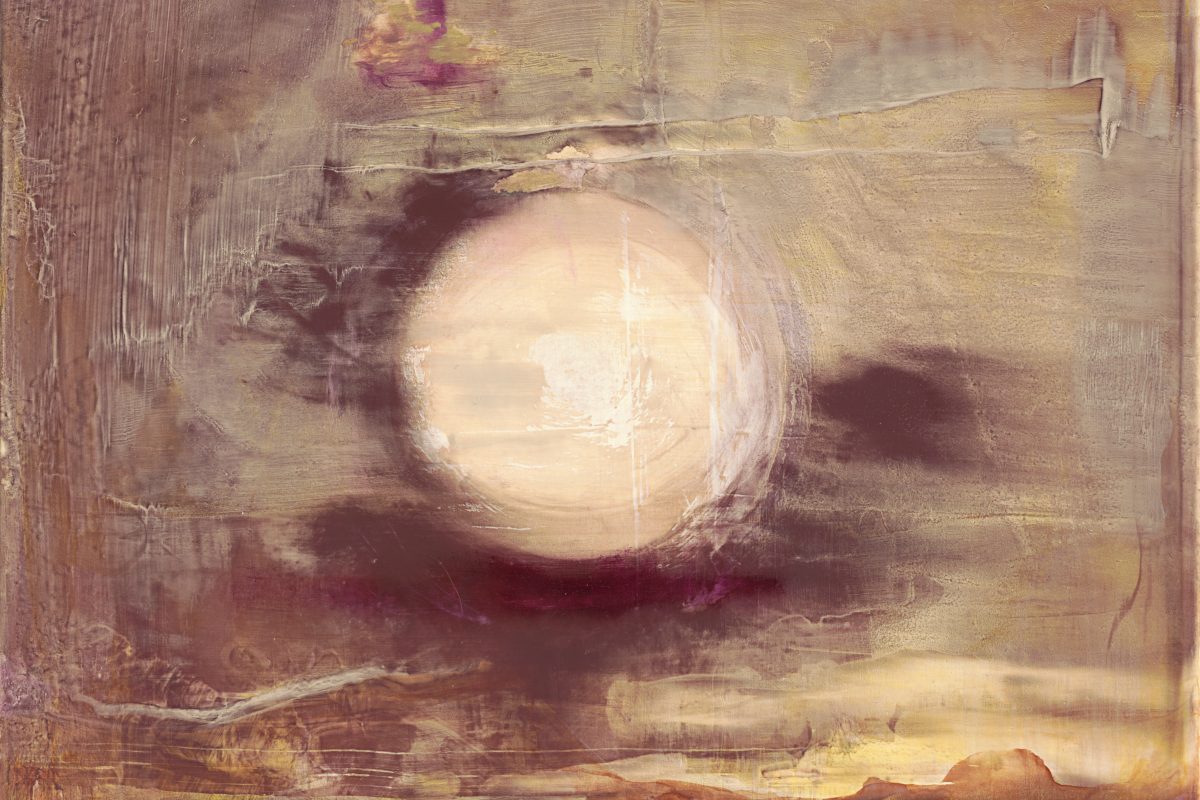
Art courtesy of Elena Brower: https://elenabrower.com/art/
Endnotes
[i] Colonial-modernity is a term that acknowledges that European modernity is a deeply ambivalent legacy that bears the constitutive signature of power exercised over ‘others’. Colonial modernity has been deeply informed by the Cartesian ontological claim, ‘I think, therefore I am’ but has always sought to underwrite its security by a constitutive claim, ‘I conquer.’
[ii] I am using the term ‘realist’ here as used in International Relations. The realist school is associated with a ‘hard headed’ view of the world as intractably fragmented, above all, in a state system that exists largely within a state of managed anarchy where order is maintained only by hegemonic powers such as the United States.
[iii] The United States Government-sanctioned kidnapping of the Venezuelan President, Maduro, was first rehearsed as an imagined scenario in the prime time thriller on American television, Jack Ryan.
[iv] John Daido Loori, 1999, Teachings of the Earth: Zen and the Environment, London, Shambala, pp. 57-58.
[v] For a hint about how a re-imagining of sangha-as-movement for social and ecological justice, fully engaged in a movement out of colonial modernity, might proceed, we need look no further than the work of Vanessa Machado de Oliveira and her collaborators at Gesturing Towards Decolonial Futures (GTDF). Central to de Oliveira and her collaborators’ insight is a recognition that our existence exists beyond the limits of language and representation. So we are called to explore not only what can be articulated but also the vast unknown and unknowable that lies beyond our stories. GTDF’s invitation to inquiry is resonant with Dogen’s ontology-as-practice:
We are not inviting you to cut open your belly to expose your guts to the contamination of the world. We are inviting you to open your belly to find the whole world – past, present, and future, the good, the bad, and the ugly – already in your guts. Then you will see that the world has been there all along in the same way that you have always been in the world’s belly, too. In the belly of the world and with the world in our belly, we are always already “in relation,” constantly interpolated and fertilized by other entities, whether we like it or not, whether we have a story about it or not. (See Vanessa Machado de Oliveira, Outgrowing Modernity: Navigating Complexity, Complicity and Collapse with Accountability and Compassion,Berkeley, North Atlantic Books, 2005, p.105)
Gesturing Towards Decolonial Futures is an international collective and practice, exploring artistic and pedagogical tools and strategies designed to “hospice modernity” and interrupt its knowledge regime, so that modernity’s grip on our collective imaginary can be loosened and disrupted. GTDF is also a practice about hospicing worlds that are dying within and around us with care and integrity while also assisting with the birth of new, potentially wiser possibilities. The Collective exhibits a rare courage in working with secret questions and levels of denial about our predicament that are, for the most part, fugitive and normally limited to the realms of the subaltern. To learn more, see Gesturing Towards Decolonial Futures website, 23 December 2024, ‘Home’ page, https://decolonialfutures.net/4denials/.
[vi] Hinton, David, Wild Mind, Wild Earth: Our Place in the Sixth Extinction (Boulder, Colorado: Shambala Press, 2022)
[vii] Eihei Dogen’s (1200-1253), Shobogenzo collection, dated 5th May, 1243. The dictum attributed to Dogen is: ’When the self advances, the ten thousand things retreat; but when the self withdraws the ten thousand things advance’. See David Hinton, Awakened Cosmos: The Mind of Classical Chinese Poetry (Boulder: Shambhala, 2019)
[viii] Clark, John, Between the Earth and Empire: From the Necrocene to the Beloved Community, (California: PM Press, 2019). See also Gary Snyder, Practice of the Wild, New York, Counterpoint, cited in Daido Loori,1999, p.71.
[ix] Joan C. Tronto, Who Cares? How to Reshape a Democratic Politics (Ithaca, NY: Cornell University Press, 2015), pg 3
[x] Cited in Clark, Between Earth and Empire, 204, taken from Sanderson Beck’s translation of the Daodejing, 10:7. Online at: www.wayist.org/lindauerdaodejing-english-translation/94-scriptures/tao-teh-ching.; Clark, John 2019, Between The Earth and Empire: From the Necrocene to the Beloved Community, CA: PM Press, p.19.
[xi] David Hinton, Awakened Cosmos: The Mind of Classical Chinese Poetry (Boulder: Shambhala, 2019)
[xii] Arturo Escobar (2015) Transiciones: a space for research and design for transitions to the pluriverse, Design Philosophy Papers, 13:1, 13-23, DOI: 10.1080/14487136.2015.1085690
[xiii] Escobar, Arturo, Michal Osterweil, and Krita Sharma, Relationality: An Emergent Politics Beyond the Human (London: Bloomsbury Visual Arts, 2024).
[xiv] Four fundamental realms of denial associated with modernity/coloniality are acknowledged with a radical courage that Dōgen would have recognized as essential companions of continuous practice for our times:
- The denial of systemic violence and complicity in harm (the fact that our comforts, securities and enjoyments are subsidized by expropriation and exploitation somewhere else),
- The denial of the limits of the planet (the fact that the planet cannot sustain exponential growth and consumption),
- The denial of entanglement (our insistence in seeing ourselves as separate from each other and the land, rather than “entangled” within a living wider metabolism that is bio-intelligent), and
- Denial of the depth and magnitude of the problems that we face: the tendencies 1) to search for “hope” in simplistic solutions that make us feel and look good; 2) to turn away from difficult and painful work (e.g. to focus on a “better future” as a way to escape a reality that is perceived as unbearable).ix
[xv] Shinshu Roberts, 2018, Being-Time: A practitioner’s guide to Dōgen’s Shōbōgenzō Uji, Somerville, MA, Wisdom Publications.
[xvi] Roberts, Shinshu, Meeting the Myriad Things: A Zen Practitioner’s Guide to Dōgen’s Genjōkōan (London: Shambala). In his Shobogenzo, Dogen (1200–1253) emphasizes the non-duality of practice and realization. This concept, known as shushō ittō (practice-enlightenment), asserts that practice is not a means to a separate goal, but the actualization of enlightenment itself.
[xvii] Han, Beung Chul, The Scent of Time: A Philosophical Essay on the Art of Lingering. (Cambridge: Polity, 2017). Steven Knepper, Ethan Stoneman and Robert Wyllie, 2024, Byung-Chul Han:Key Contemporary Thinkers, Cambridge, Polity Press, p.131.