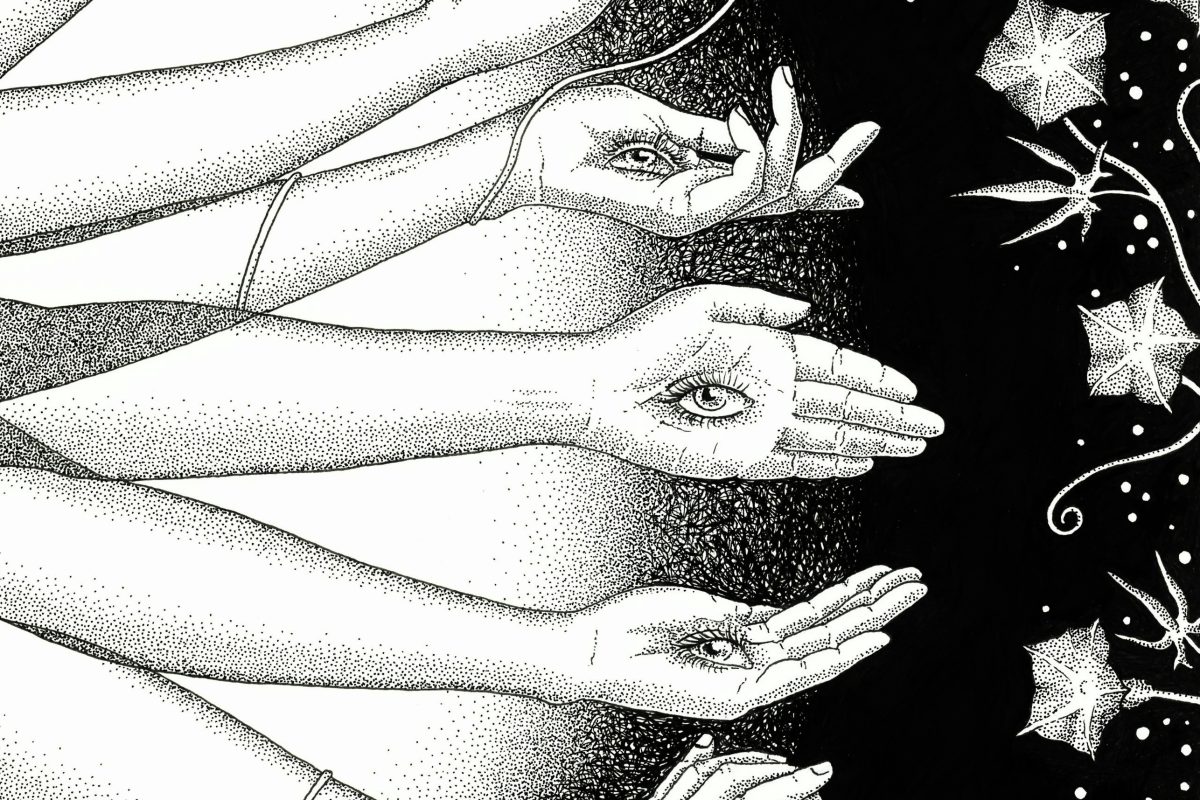
An Ode to Vultures, Sky Burial, and Kali Ma
My eyes adjust to darkness. More evolved creatures know this, do not fear dusk but come fiercely
alive in its violet tunnel. Coyotes, bush cats, vultures— eternal mothers and daughters conceived by wind, winged pneuma. From what other scavengers can I learn? What tricksters and soldiers? I am dim, stunned.
I recently rediscovered these words I scrawled in a journal entry five years ago, steeped in grief. The sense memory of that darkness feels appropriate to autumn’s approach here in the northern hemisphere. What insight could I offer in the yearly descent to darkness, in an age of darkness? Like I did five years ago, I must defer to the crepuscular and carrion-eating. Like the vultures that eat flesh from sky burials, I want to keep my eyes open to the life-sustaining potential in death: the death of our sociopolitical systems, of our expectations of civilization, of my ego.
Easier said than done. What about the death of entire species and languages, of our most innocent, of the children that James Baldwin reminded us are “always ours, every single one of them, all over the world”?
The need to grieve and bury our dead is overwhelming. This is treacherous work—work that one cannot easily turn back from, once started. But in doing so, in doing the shadow work and meeting our unmet needs and resourcing ourselves, it can be easy to forget that it’s not the full extent of the work. Like Persephone returning to the earth’s surface each spring, rejoicing in what sunlight and life exists can realign with our intentions. As one of my dharma teachers once reminded me, “You do not need to feel guilty for having access to joy or resources or love. Do not hoard them, but do not disrespect their preciousness, which mirrors the preciousness of our suffering, by ignoring them. Let it all move freely.”
That phrase—the preciousness of bliss (joy, contentment), which mirrors the preciousness of suffering—haunts me. The separation does not exist. The guru principle reminds us that every facet of experience can be seen as an extension of the guru. When approached with curiosity and equanimity, the moment of contact and reaction with anyone and anything can teach us about our psychological, physical, and spiritual impulses. Even the crumbling of outdated or oppressive systems can feel terrifying: the death of what we know. In bardo practices, we are urged to remain steady, lest the visions of our karma draw us into a painful, distorted new incarnation. Perhaps the movement chaplain is analogous to a bardo guide: to be patient at these sites of transformation—to hold the zone, to steward the death of what needs to die, and to pay attention to what we create in the wake.
In the Devī Māhātmya, Kali Ma—the tantric goddess of time and death—assists Durga in subduing the demon Raktabīja and his countless manifestations. In other accounts, even Yamarāja (the Lord of Death) fears her, suggesting that something in her representation and energetic archetype challenges the finality of death itself. Lord Siva, her consort, by some accounts lays down before her to try to quell her rage, lest she destroy the universe itself. The moment of her enraged body touching the devoted, loving body of her consort subdues her wrath.
This moment of contact brings me to tears. In it, I feel the potency of her wisdom distilled: to transmute the violence and disorientation of death and darkness—to absorb its charge and be fueled by it—but never at the expense of our tenderness. To metabolize impermanence and destruction in service of connectedness and continued life, in whatever surprising forms it may take. In Hindu cosmology, we are said to be in an age of darkness: a Kali Yuga. In such times of contraction, even “true” dharmic teachings become hard to distinguish from false or distorted ones.
Working on this issue has afforded me an intimate view of how chaplains, spiritual leaders, teachers, and organizers conceive of the work, and some of what’s being done. I have learned so much from the wisdom and generosity of everyone who’s helped this special issue come together.
May all of our work, not limited to the page, be in service of liberation for all. May Kali Ma remain close and help us cut through delusion and ego-clinging and harm, over and over. May the countless deaths, of beings and systems and ways of being, never be in vain. May all beings, without exception, be free.
With metta,
Mishka Erdenesanaa