
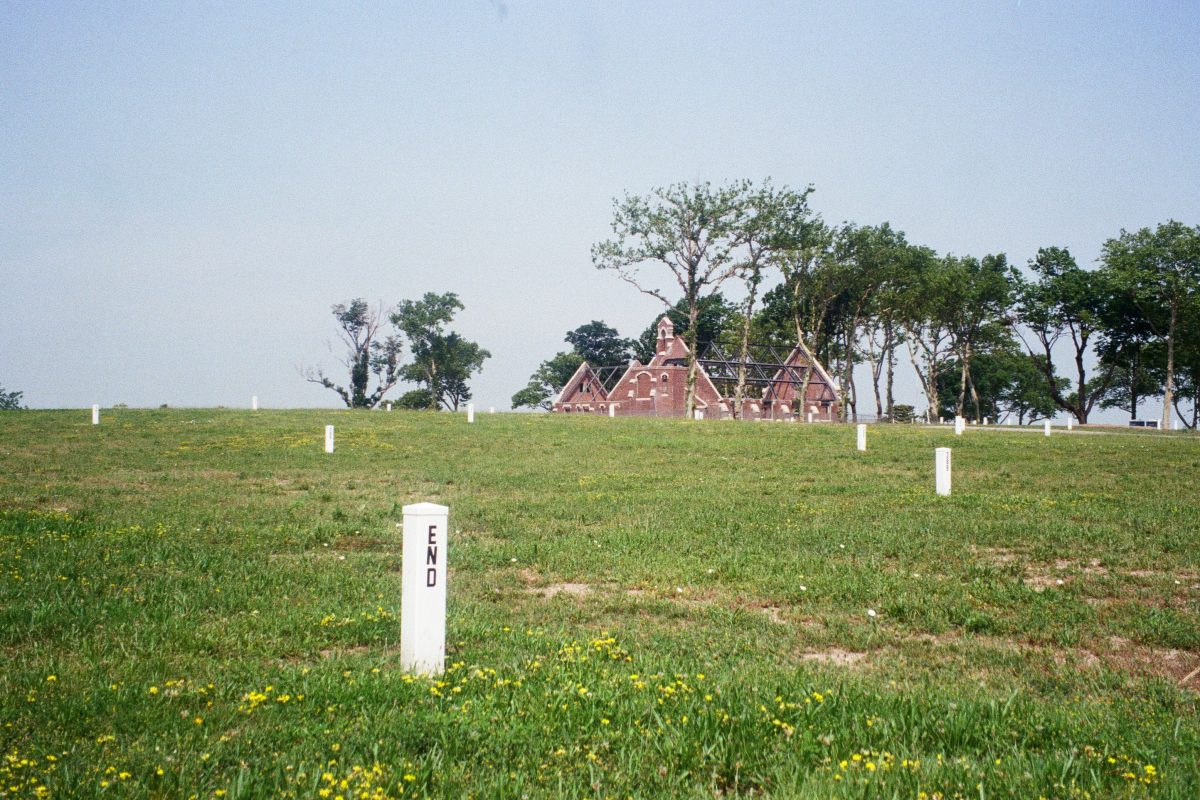
“Then Judas, who had betrayed Him, saw that he was condemned, repented himself, and brought again the thirty pieces of silver to the chief priests … and they took counsel, and bought with them the potters field to bury strangers in.” – Gospel of St. Matthew (27:3-8)
When a spirit, a mindstream, a bundle of karmic tendencies slips from the body like a tight shoe, or–for the materialists–when the life force of an organism is stamped out by the natural laws of death, its once-animated form is left behind. What will come of this form?
From the beginning, homosapiens have devised an abundance of ways to deal with our dead. We bury them (in the ground, at sea, in caverns), burn them, entomb them (the Great Pyramid!), compost them (green burials), and ceremonially dismember them on high mountain plateaus where carrion eaters have received human corpse offerings for generations (look up Tibetan sky burial for more on that one).
But what of the dead who, in the cold atomization of modernity, die alone, unclaimed, anonymous, or in the care of loved ones unable to afford multi-thousand-dollar burial fees?
Here in New York City, our answer to this question is Hart Island–a 130-acre strip of land off the coast of the Bronx in Long Island Sound, that for the past 157 years has been used as a “potter’s field,” a final destination for those departed beings deemed by the city to be unclaimed or unidentified.
Until 2021, Hart Island was managed by the Department of Correction, closed to the public. All interment labor was performed by inmates of Rikers Island for 37 cents an hour. Control of the island has since been transferred to the Department of Parks and Recreation, and burials are now conducted by city contract workers. The public can now register for tours held on select Tuesday mornings through the NYC Parks website.
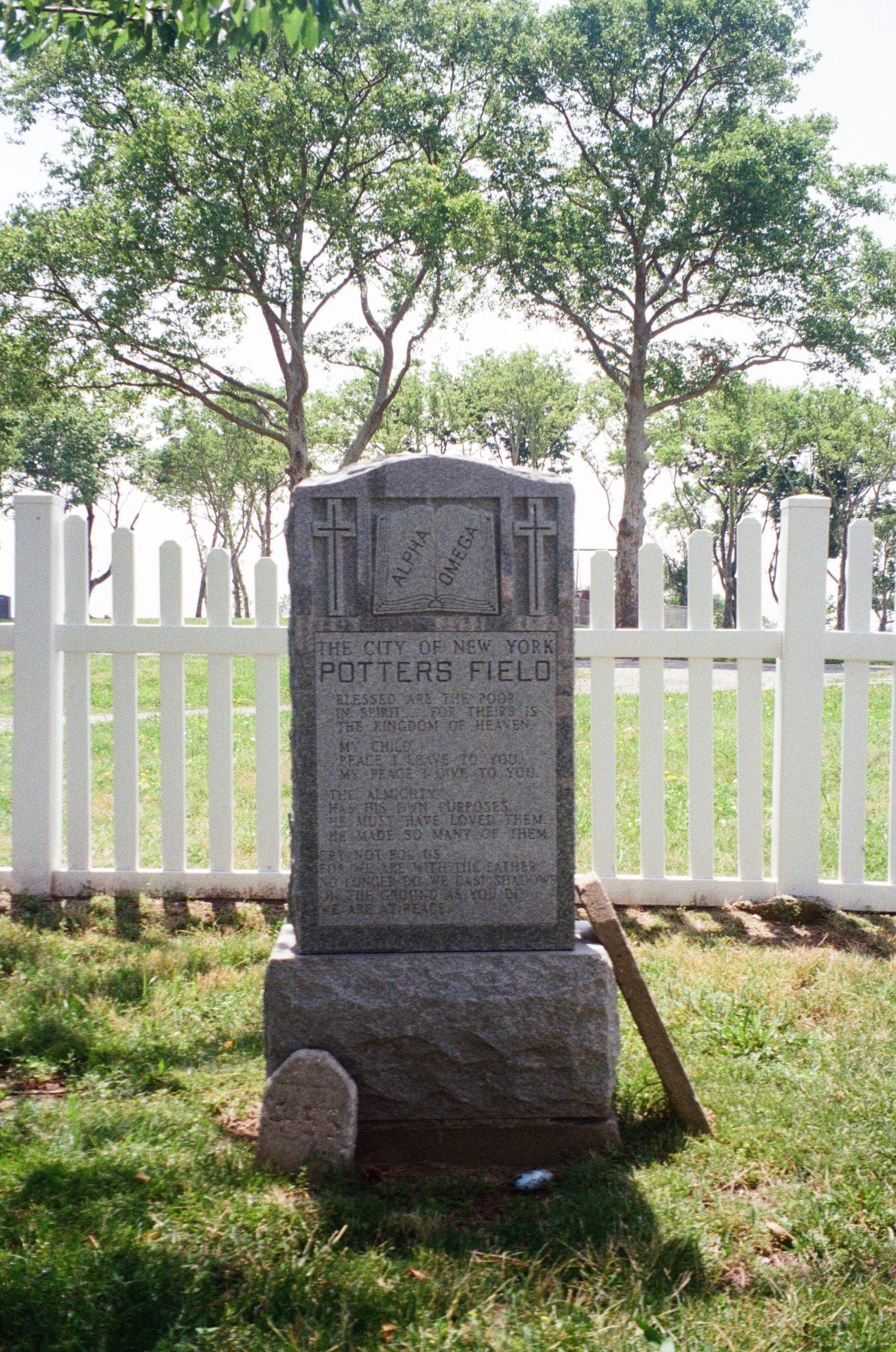
Hart Island wasn’t always a potter’s field. As with all land “belonging” to the American Empire, it used to be stewarded by people the empire has desperately tried (and failed) to disappear, all but scrubbed from our nation’s records. In 1654, one Thomas Pell purchased the land from the Siwanoy people, and so began a surreal progression of piecemeal ownership through many different hands, each with their own idea of what to do with the humble island.
A brief list of Hart Island’s previous incarnations: host of underground bareknuckle boxing matches; training ground for the 31st Infantry Unit of U.S. Colored Troops during the Civil War; home of the Industrial School for Destitute Boys; a quarantine site during the Yellow Fever epidemic (1795-1804); an insane asylum; a Civil War POW camp; Navy barracks during WWII; a jail for New York’s incarcerated overflow; a Phoenix House narcotics rehab facility (which occasionally held music festivals, drawing names like The Velvet Underground and Janis Ian); and underground storage for supersonic missiles during the Cold War (1955-1961).
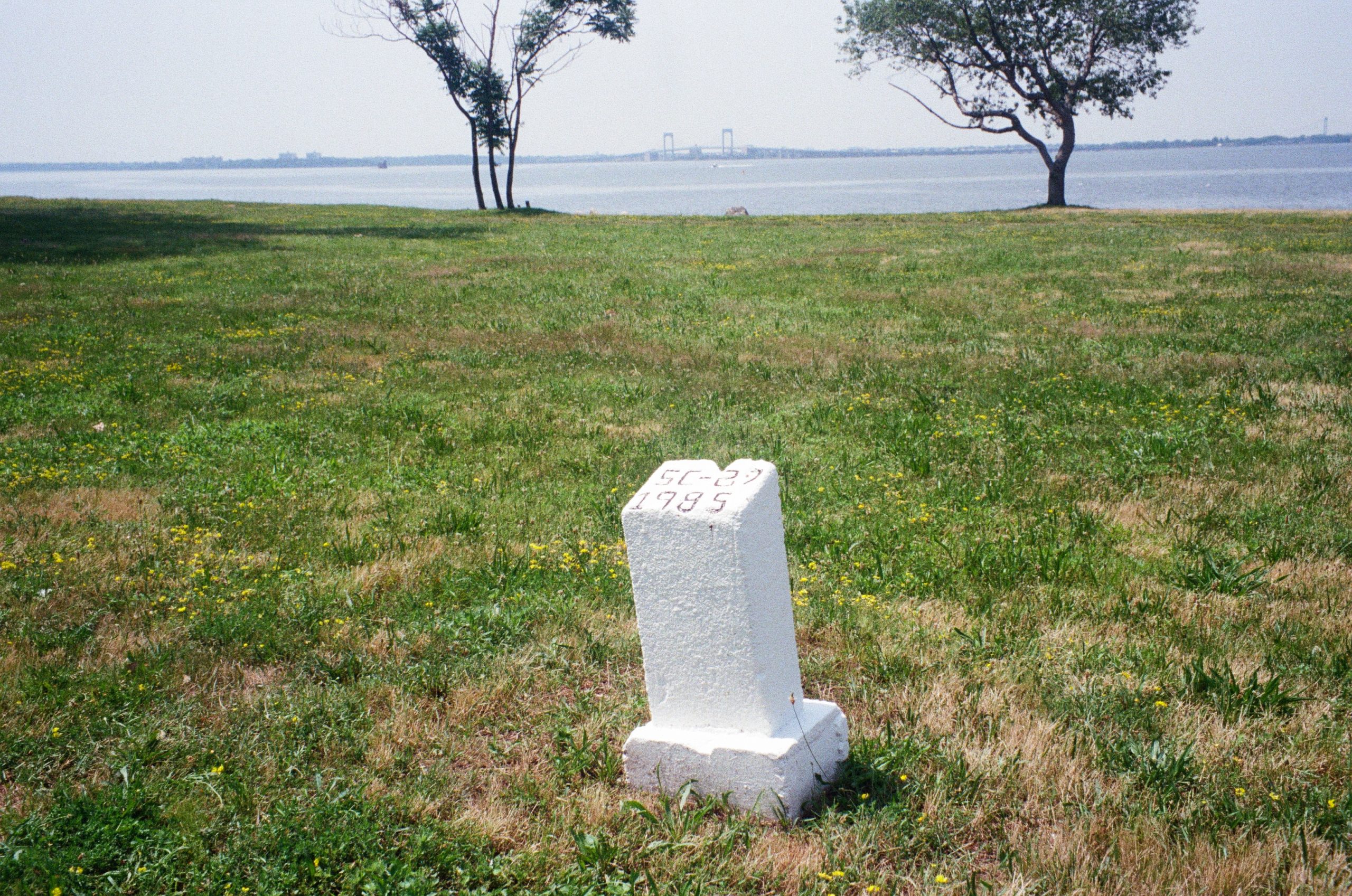
Since becoming a public cemetery in 1869, roughly a million New Yorkers have found their final resting place in Hart Island’s vast grid of trenches. An estimated one-third to one-half of them are children under five years old who died in NYC hospitals; in many such cases a parent had signed papers authorizing a “City Burial,” often unaware of what exactly that meant. Hart Island burials spiked during the AIDS epidemic of the ’80s and ’90s, when, amidst ignorance and chaos, funeral homes started rejecting bodies killed by the virus. The first 35 AIDS patients to be buried on the island were interred individually, 14 feet deep; the only individual interments on the island. A particularly potent grave marker on the southernmost tip reads “SC-B1–1985”: Special Case Baby 1. This marks the island’s first infant known to have died of AIDS. The child’s grave stands entirely on its own, several yards off from the other already isolated AIDS patients. SC-B1’s identity remains a mystery.
When I took the public tour at the end of June, six Urban Park Rangers served as our guides, and I noticed at least half of them quietly weeping throughout the tour. SC-B1 had the whole team choked up. As Ranger Lenora tried her best to get through an explanation of the grave without breaking down, we heard intermittent bursts of clatter that sounded like hundreds of distant firecrackers going off at the same time. It was the NYPD’s training facility shooting range, we were told, which stands just across the channel. The sonic shadow of a militarized and omnipresent police state.
 Nowadays, Hart receives about 1,500 pine boxes annually, each labeled with whatever information on the deceased is available, along with an identification number. Then into the mass-grave trenches they are buried, perhaps first receiving a blessing from Hart Island’s staff chaplain (a position formerly held by my root teacher, Lama Justin von Bujdoss), all of it mutely witnessed by the wind-swept, corpse-laden island.
For many, learning about Hart Island—and the city’s machinations played out upon it— doesn’t sit well. But the phenomena of the unclaimed dead is a reality, so what would we have the city do differently? What is the dharmic approach to the situation? Dharmic as in not only preventing harm, but actively relieving suffering as well. I don’t know the answer to this question, but I know it is worth asking.
For one thing, we can begin to envision a reality where the spiritual virus of capitalism is dismantled, and with it burial fees that price out entire populations from “claiming” their dead loved ones. As it is, rituals of honored identification and remembrance are being withheld by the marketplace of death industry. As a simple given, let us insist that whenever possible the remains of all human beings be processed by their own communities exactly according to their deepest wishes. Let’s also address what I think is an all-too-common and perhaps unconsciously-made assumption of the karmic equation here: that there is some inherent lack of dignity in being buried on Hart Island. But is there?
On the relative level, there’s no fault in being disturbed by the prison-industrial complex and its essentially unpaid labor practices–the blatant continuation of what was once called slavery in America–and by the notion of a remote and closed-off burial ground of mass graves for the anonymous and the cast aside. Isn’t it our responsibility to heal the spiritual ails that give rise to phenomena like Hart Island, where the pain of being declared forgotten and abandoned, faceless and nameless, hangs like a mist? Of course, it isn’t that simple. It never is.
We want to define everything, to make it hold still, because then we can get our footing, we can conjure some illusory ground on which to stand. We pin it down, define it, make sense of it, and project meaning upon it. Now that it means something, we can judge it. Discussing Hart Island with Lama Justin, he told me, “You know, my feeling about Hart Island is that people project a lot onto this place that is sacred. What makes it sacred? The bodies make it sacred. This being the resting place for so many people. The fact that it holds the remains of those who died from the flu pandemic of 1918, and before that from Yellow Fever and Typhoid, the AIDS crisis, Covid… This is what makes it sacred.”
Still, we may well feel a righteous anger at what appears to be unjust. But justice for whom? Justice for the deceased? Or justice for the living left behind who struggle to make sense of an urban planning conundrum? And perhaps the real question: do justice and death ever mix? Then there’s the prison labor aspect. I know many of us recoil at the idea of people in custody burying bodies for less than a dollar a day, but, as both Lama and the Urban Park Rangers pointed out, such a work assignment was a coveted position. The job was peaceful, out in nature, and one was a lot less supervised. Lama went on to say, “These places are complex. When we only look at things from the view of one particular location to power, everything else becomes colored by that. And this is exactly what Dharma is about too. When we shift perspective to a much wider lens, we see all the complexity, and that complexity also reflects a tremendous amount of beauty, an existential beauty.”
And on the absolute level, what about the dignity of Hart Island’s vast community of the dead? From this perspective, the whole question becomes absurd. In reality, there is not an iota of “dignity” taken from the lives, and deaths, of these beings. There is no such thing as an undignified death. Beings take birth, remain for a time at the intersection of awareness and appearances (i.e. experience), and depart. All life—and thus all death—is a playful expression of awakened mind, freely dancing in the not-two-ness of form and emptiness. So whether a body lies in Greenwood Cemetery in Brooklyn (a kind of polar twin of Hart Island, where in the mid-19th century wealthy Manhattanites would send their dead on river-crossing ferries to the Gowanus Bay, and then by horse-drawn hearse to Greenwood), or in Hart Island, there is no real distinction to be made. One is not of greater worth than the other. A mindstream took birth, the material vessel expired, and its molecules scattered in space-time. Our divine nature is inalienable. Nothing and no one can diminish the inherent worth of consciousness taking form, and dropping form. The only dance there is. Breathing in, and breathing out.
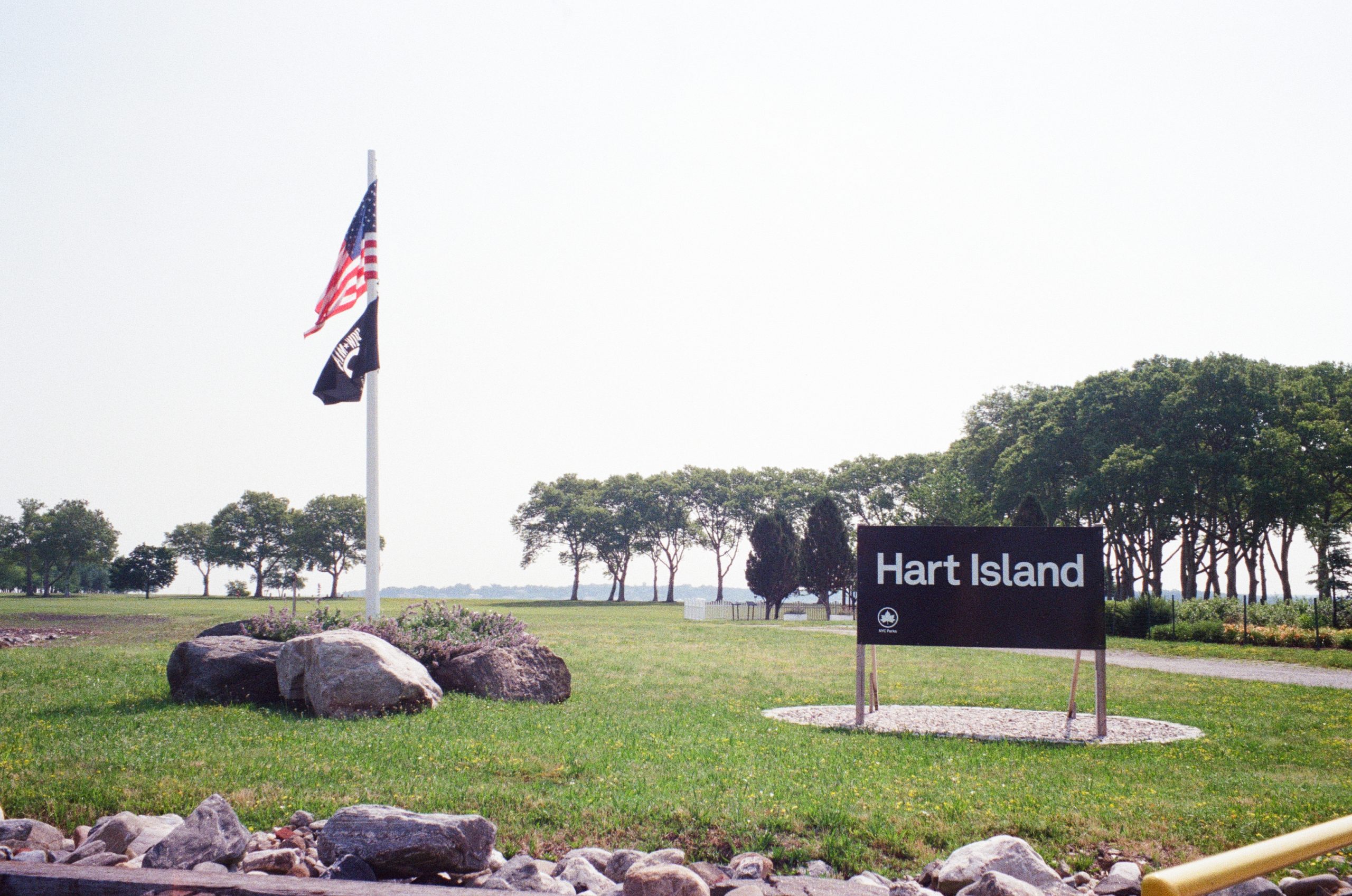 When I visited Hart Island, I asked one of our guides how the city is facing the inevitable day the island reaches capacity. She said they have yet to re-use a single plot, though estimates place that juncture of critical mass coming within the next 10 to 20 years. As of now, there is no plan for how to proceed beyond that point. Also at play is how climate change is acting upon the physical dimension of Hart Island. The southern part of the island is only one or two feet above sea level. It flooded during Sandy, and there was considerable erosion on the shoreline that had to be mitigated by FEMA support. So even the land itself is not fixed.
Lama Justin told me how peaceful he found the land to be when he was still the chaplain of Hart Island. Back then, the island was teeming with Datura—a nightshade flower, ghostly white, that is both lethally poisonous and extremely psychoactive, depending on the dose. Since the Parks Department took over, the island has been manicured and well-kept; clean lawns have replaced the wild overgrowth of the DOC years. Datura has been used for millenia as a ritual hallucinogen by cultures spanning from India to the Indigenous Americas. Lama Justin felt the plant spirit was right at home on the charnel island. In Buddhist tantra, much focus is given to the idea of transmutation. We practice in order to transmute the five poisons (attachment, aversion, confusion, jealousy, and pride) into wisdom. These energies themselves, whether experienced as poison or wisdom, are one and the same. It’s what we do with them, how we relate to and identify with them, that is transformed.
The plant spirit of Datura can kill you, or it can be a visionary guide. There are endless healing modalities that can cause incredible harm, whether by being taken out of context, administered in excess, or used to treat the wrong ailment. Governments use forced isolation and sensory deprivation as instruments of torture. The Tibetan practice of dark retreat (Lama Justin’s heart practice) can vaguely resemble such methods in form, but when done voluntarily and held within the container of a spiritual tradition, a qualified teacher, and techniques developed over millenia, it has the potential to be profoundly healing. Medicine can be poison, and poison can be medicine. Healing technology, whether medical or spiritual, is not fixed either.
What is the poison when it comes to Hart Island? Is it death? Poverty? Societal values? And can there be transmutation for its buried beings? I think so. The site of such transmutation is in how we, the living, hold them in our hearts and minds. How we connect with the dead, both in spirit and on the physical plane. This is where movement chaplaincy and Hart Island can blend into fertile ground. If you are passionate about chaplaincy and social activism, visit the island, take a public tour. Bear witness to the grave sites and to the land itself. As both spiritual practice and fuel for your activism, see their sacred nature, indestructible and utterly beyond the causes and conditions that led them there. Allow whatever afflictive emotions may come to arise unobstructed, blooming into their innate wisdom nature, and let that wisdom energy pervade all your activities in the world.
As Lama Justin said, “The grief is shared by all, grief is not just the pain of the dispossessed, or the pain of the poor. The wealthy feel grief, the wealthy feel loss as well. Solidarity with those who have less means who are buried on Hart Island—solidarity with marginalized communities—is an existential thing, and it’s beautiful. But political liberation and spiritual liberation are not the same, from the Buddhist view.” Political freedom and political power do not ensure the transmutation of attachment, aversion, confusion, jealousy and pride. Certainly, political freedom is conducive to the work of spiritual liberation, but we ought not to confuse the two as interchangeable. Nor should we wait until political freedom has been secured to begin our spiritual liberation practice; an error which would only lead to the stuckness of samsara grinding on forever.
Having taken the ferry across the channel through the hazy dawn, Lama and his colleagues (the aforementioned Rikers inmates) set foot onto the forgotten shore of New York’s forgotten dead. Meditating on impermanence and the inherently liberated nature of mind, always armed with a Bible, Torah, and Qur’an (in case the deceased’s faith tradition could be identified), and reciting prayers from his own Vajrayana Buddhist tradition, Lama Justin would set about blessing each pine box that came off the New York City morgue truck. Throughout the COVID pandemic, he returned to the island many, many times.
It’s a special sort of chaplaincy, when all those in your spiritual care are already dead, and you’ll never see their faces. If you’re lucky, you might have a few scattered details of their identities. The Buddhist chaplain knows that time does not exist, and that all those past iterations of the land are invisibly vibrating, always. Spiritual care is happening on the subtle planes of sheer presence, of softly uttered prayers and quiet bows. Eventually, Charon comes back, chaplain and inmates reboard the ferry, and they begin the journey back to the land of the living. The cool dark of night embraces the island, the ghost flowers bloom, and the forgotten dead dance upon supersonic missiles, singing together in the rich acoustics of abandoned mental asylums.
Meanwhile, across the Long Island Sound, 8.5 million New Yorkers breathe in and breathe out, each one respiration closer to the Universal Fate of all sentient beings.
Sean Fentress is a student of Union Theological Seminary and Hunter CUNY completing his M.Div and MSW in the two schools’ dual-degree program. Sean is also a founding member of the band Straw Man Army, and a practitioner of Vajrayana Buddhism under the guidance of his teacher, Lama Justin von Bujdoss.
*This essay is featured in our special issue, “Movement Dharma: Towards a Buddhist Movement Chaplaincy.”


