Interviews

Rangzen: The Movement for a Free Tibet and a Call for a Decolonial Movement Dharma

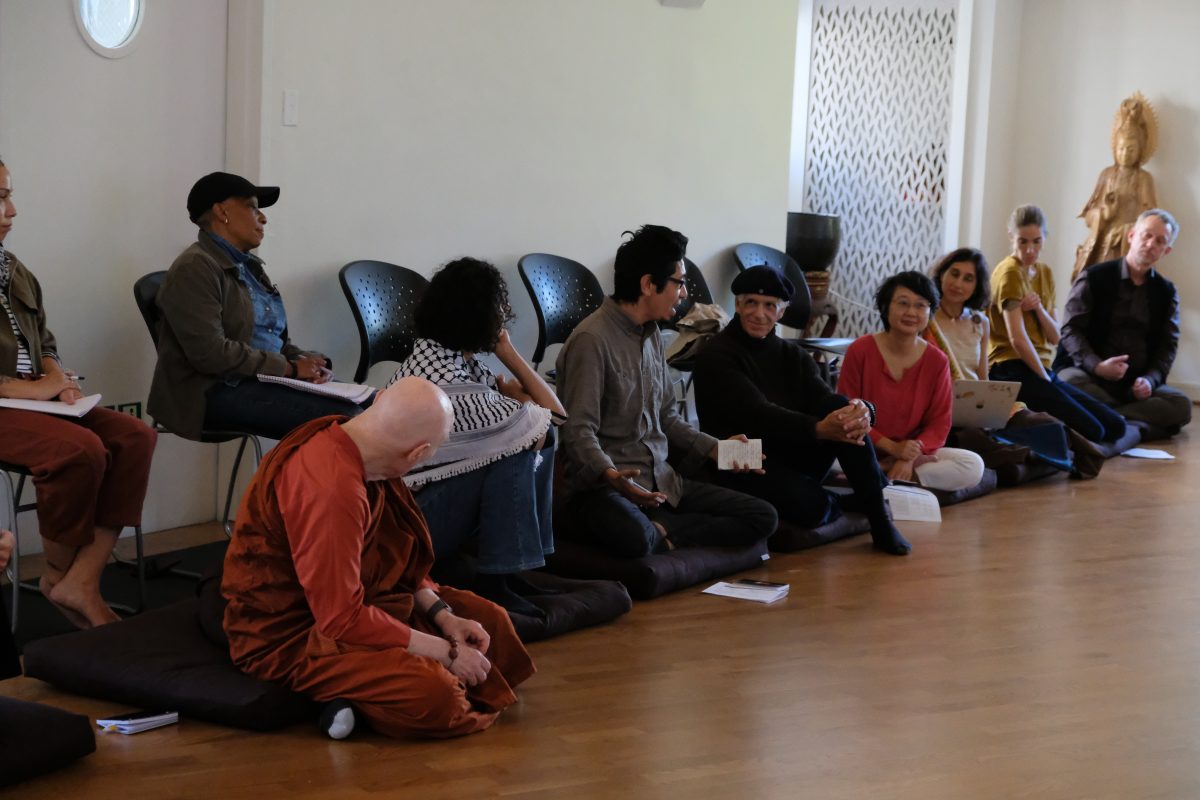
Editor’s Note The following interview with Tenzin (Tendor) Dorjee, Director of Research and Advocacy at Tibet Action Institute, and former director of Students for a Free Tibet, took place over thali and momos in Jackson Heights, Queens. It has been lightly edited for clarity and flow. I was eager to speak with a leader of Rangzen—the Tibetan Freedom movement—about Buddhist movements for liberation and the perceived support for this movement among contemporary Buddhist practitioners in North America. In the spirit of this special issue on Movement Dharma, which aims to (re)awaken political consciousness and engagement among Buddhist practitioners, it felt necessary not only to center indigenous decolonial movements, but also to honor the lineage and culture of Tibetan Buddhism, from and through which so many of us practice and have received teachings. Tendor and I met shortly after the self-immolation of Tibetan activist, Logba Rangzen. In protest of China’s ongoing occupation and cultural genocide of Tibet, Logba Rangzen self-immolated in front of the United Nations on July 2, 2026, the day after China announced its …

In Conversation on the Climate Crisis: An Interview with Kristin Barker

This interview appears in the issue “Rest and Creativity” (Volume 9, Number 1). Click here to subscribe and download the entire issue.  The Arrow’s Chief Editor Gabriel Dayley sat down with Kristin Barker, co-founder and director of One Earth Sangha, for a conversation on applying Buddhist teachings to show up with bravery and skill in the face of climate disruption. One Earth Sangha’s mission “is to support humanity in a transformative response to ecological crises based on the insights and practices of the Buddhist tradition.” The conversation explores working with the emotional toll of the climate crisis, understanding how humanity arrived at this juncture through a Buddhist lens, and how we can arouse fierce compassion in the years ahead. • • • Gabriel Dayley: In your work, you’ve spoken often about the importance of “normalizing our emotional responses” to the climate crisis. Could you say more about what you mean by that and why it’s important? Kristin Barker: In Buddhism, there is an invitation to pause and begin with our own experience, and to investigate closely what’s …

Reimagining Rest: An Interview with Aarti Tejuja & Sojourner Zenobia

This interview appears in the issue “Rest and Creativity” (Volume 9, Number 1). Click here to subscribe and download the entire issue.  The Arrow’s Managing Editor shah noor hussein and Chief Editor Gabriel Dayley had the opportunity to speak with Sojourner Wright and Aarti Tejuja, co-founders of Antara, whose “mission is to facilitate the transformative space of the in-between so that inner change can guide us to collectively build a more interconnected and liberated world.” On their website, Aarti and Sojourner observe, “antara is a Sanskrit word meaning within, in the middle, between.The in-between space is where rest, creativity, healing, learning and evolving happens.” We asked them about their experience of rest and creativity in their personal lives and work. • • • Gabriel Dayley: Welcome! Sojourner, Aarti, thank you for joining us for this interview. shah noor, would you like to start? shah noor hussein: I’m really excited to have this conversation with all of you. We wanted to start by asking what insights arise when you rest, reflect and recuperate? What wisdom bubbles up to the …

In Conversation: LaDawn Haglund and Adam Lobel

This interview appears in the issue “Healing Social and Ecological Rifts Part 2″ (Volume 8, Number 2). Click here to subscribe and download the entire issue.  LaDawn: We are beginning our dialogue on Part 2 of “Healing Social and Ecological Rifts,” a two-volume issue in The Arrow Journal. I’m here today with Adam Lobel, and I am LaDawn Haglund, guest editor for this special issue. Hi Adam! Adam: Good morning, LaDawn! LaDawn: I wanted to get started by laying the ground: why we’re having this dialogue, what is bringing each of us to the table to discuss the issues raised by these articles and what they evoke for us in terms of learning or developing our ideas, or for moving forward with heart into the world.  Adam: Why don’t we start with you? You’re a busy professor and have a lot going on. Why did you choose to take up this pretty significant task of editing two volumes and taking on this special issue? LaDawn: First, I want to thank Gabe Dayley, Chief Editor of …