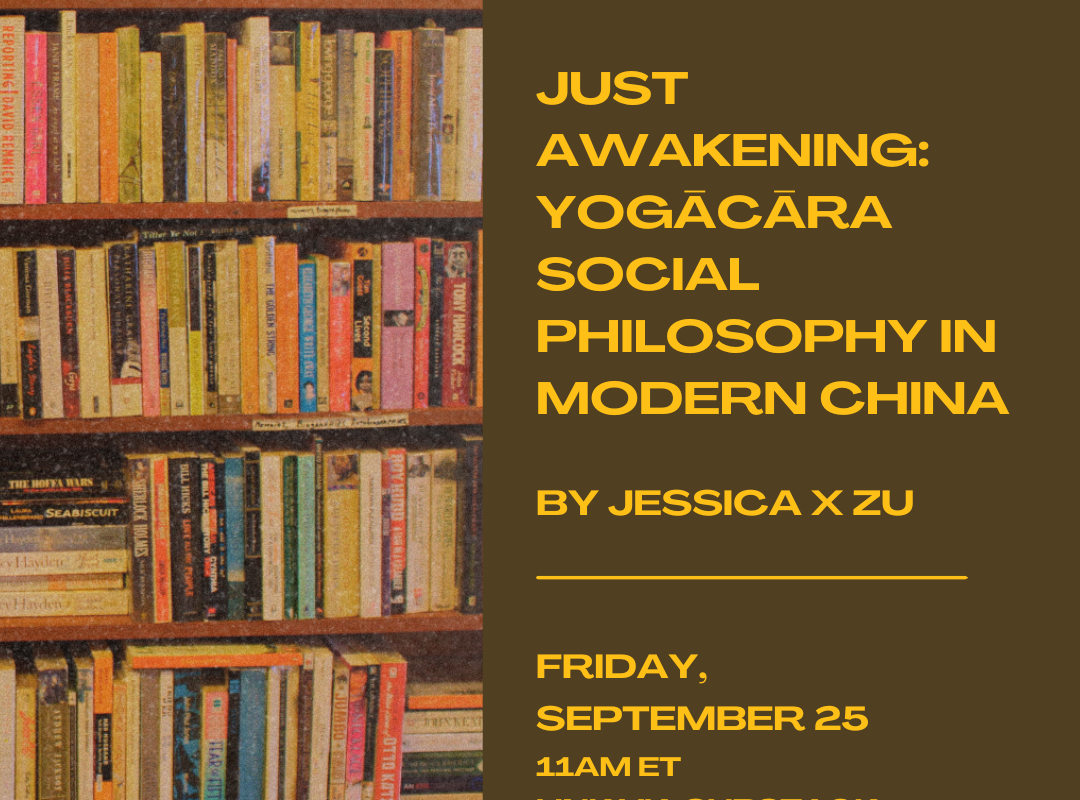
Just Awakening: Yogācāra Social Philosophy in Modern China, by Jessica X. Zu, is a work of “liberation Buddhology” that explores how early 20th-century Chinese intellectuals drew upon Yogācāra philosophy to build an irresistible, revolutionary activist movement to bring forth a nonviolent, just society. The book, which just won the prestigious Toshihide Numata Book Award in Buddhism, offers a compellingly clear account of what Zu terms “socio-soteriology”, a new revolutionary project of social philosophy and praxis.
The following interview is from our forthcoming special issue, “Movement Dharma: Towards a Buddhist Movement Chaplaincy.”
Brooke: I was tremendously excited to talk with you about your book, Jessica, and to introduce our Arrow readers to this outstanding text. As a community, we’ve been engaging deeply with concerns around collective liberation and themes of pluriversality, and the question of how to build more loving, just, relational, and non-dominating communities and societies. Your book offers us a path forward, and it also speaks directly to the heart of this special issue, “Movement Dharma,” and its concerns with what the dharma might offer this moment.
Jessica: Many thanks, Brooke, for inviting me here and for helping me broaden the implications of my book beyond its narrow academic interest. I’m excited to share my two cents with Arrow readers and learn from them how to keep scholarship relevant and accountable to the frontline activists building our pluriversal futures of relational non-domination.
Brooke: I love this phrase, “relational non-domination”; I think it is such a clear and powerful way of communicating freedom in connection. What brought you to this book, to Yogācāra Buddhism, and to your own understanding of collective liberation, or freedom?
Jessica: To be honest, when I chose to work on modern Yogācāra, I had no idea that it has such deep connections with social justice and epistemic justice, especially how to do scholarship when your own knowledge tradition was the target of what Boaventura de Sousa Santos termed “epistemicide.” How to survive and gain the power to make one’s own system legible in an epistemicidal environment, and how to do prefigurative scholarship that refuses to reproduce our inherited patterns of epistemic domination, but instead builds toward Santos’s vision of “ecologies of knowledge” or Arturo Escobar’s vision of pluriversal futures. Also, I only got to know about Escobar’s and other visions of pluriversal politics after my book was published and after some readers brought up this connection.
What brought me to research for this book was a combination of personal aspirations and academic viability. This is my dissertation book, so it was meant be a tenure book, meaning that I wrote this book for academic readers only so that I get job security to produce more scholarship later. But I was doing my second PhD, so I needed it to be about things I care deeply about. I was born and raised Pure Land, the kind of low-brow easy path for common folk without much epistemic authority. Chinese Pure Land has long worshiped the ancient Buddhist philosophers Nāgārjuna and Vasubandhu as Pure Land ancestors, role models to emulate. So, when I was a kid, my Pure Land aunties (most of them illiterate or semi-literate) would often cite verses—purely from memory—in our daily conversations. We would refer to each other as dharma brothers, and they would reward me if I could recite verses like:
心意識了名之差別。 (Twenty Verses, T. 1590)
(Mind [Citta], Intellect [Manas], and Consciousness [Vijñāna] are differentiated by name.)
內識生時似外境現。由假說我法 有種種相轉 彼依識所變 此 能變唯三; (Thirty Verses, T. 1586)
When the internal consciousness arises, it manifests as if it were an external objective realm. The metaphors of ‘Self ’ [Atman] and ‘Phenomena’ [Dharmas] are conventionally designated, evolving into various manifestations. These manifestations are based on the transformations of consciousness, and these consciousness-transformations are of only three kinds.
不生亦不滅,不常亦不斷;不一亦不異,不來亦不出. (Root Verses of the Middle Way, T. 1564) Neither arising nor ceasing; neither permanent nor annihilated; Neither identical nor different; neither coming nor going.
Then later on, when I grew up and got into college, I realized that they were using very high-brow scholastic Yogācāra and Mādhyamaka treatises by Vasubandhu and Nāgārjuna. This contrast caused quite a bit cognitive dissonance for me: what does an abstruse scholastic treatise have to offer to my mostly illiterate Pure Land aunties who were just trying to survive and, at the same time, make sure kids like me do not starve?
Academically, few scholars have seriously studied Yogācāra in modern China as philosophy. So I figure, I owe myself to give it a try. Also, as a Pure Land practitioner, my vision of Pure Land is the father of modern Yogācāra, Yang Wenhui’s; he literally wrote that Amitābha’s Pure Land was like a modern school where everyone can learn whatever they want for free, not just free of tuition, but also with free food and free boarding. Getting into a PhD program supporting me to nerd out on Yogācāra is very much like living in Pure Land for a few years.
Brooke: Thank you for sharing some of your personal history! Your book centers on the work of Lü Cheng, a 20th century Chinese Yogācāra thinker, and other contemporaries concerned with building a nonviolent, just society. What was happening in movements for justice in China at this time, from which this work emerged? What is the relationship between Lü Cheng’s liberation work and actual movement organizing on the ground?
Jessica: I chose to work on Lü Cheng not because he has broad on-the-ground impact. The institute he helped build, 支那內學院(’China Inner Learning Institute’) has abysmal social impact but, academically, they were the best of their time, well-respected by most Chinese intellectuals as a force to wrestle with. This broad recognition by the mainstream, non-Buddhist, Confucian, Christian, secular intellectuals, for me, means that they’ve done something right in dealing with the epistemic domination and in making themselves legible in the secularizing world. The secularist knowledge system, at the time, meant everything Western: social Darwinism, a mechanical worldview where objective truths reigned supreme, individualism, “survival of the fittest,” and later turned into class struggle and clash of cultures.
Their lack of social impact, I now understand, is not due to lack of effort (everyone at the Inner Learning Institute was working so hard, under dire living conditions), but due to lack of supportive conditioning. Twentieth-century China was tumultuous. Not unlike the apocalypse in Octavia Butler’s Parable Series. For example, in 1943-44, Lü Cheng relocated the Inner Learning Institute to Chongqing, due to the Japanese invasion. While he was teaching Yogācāra bodhisattva ideals—ideals of democracy—the Japanese war planes were dropping incendiary bombs, the city was burning, and there were decaying corpses on the street. The government could not clean them up fast enough. Under such conditions, when everyone else was shouting “survival of the fittest,” Lü’s courage to say “survival of the friendliest” and refusal to fall back into what Walter Wink called “the myth of redemptive violence”—meaning using “good” violence to end “bad” violence, which in reality only legitimizes violence as a means to solve social conflict and leads to new structures more abusive, more domineering than the oppressive infrastructures they tore up— for me, that’s brave and amazing, and his vision needs to be kept alive for generations to come.
Brooke: What, if any, parallels can we draw between those struggles and the struggles in our movements right now, especially in regards to violence and the logic of domination?
Jessica: So many that I can see. If our goal is to dismantle what bell hooks termed “dominator culture,” and to build pluriversal futures of care and love, then Buddhist traditions have a lot to offer. For example, casteism is the oldest form of racism, or any birth-based discriminative social arrangements of domination-submission. Buddhist traditions, for about 2500 years, have recorded in writing their own struggles and failures to dismantle different mutations of dominator cultures and dominator systems and most important of all, dominator mentalities. All those written records are treasure troves for us to learn from both their successes and failures as we move forward.
Many Buddhist or buddhish groups are doing that right now. My own terms socio-soteriology and liberation Buddhology are just a more academically legible way to express what many Black Buddhists and Ambedkarites and engaged Buddhists are already practicing. For example, Larry Ward on America’s racial karma, or rev. angel kyodo williams’ “without inner change, there can be no outer change. Without collective change, no change matters.” Or what Dr. Rima Vesely-Flad observed in her work on Black Buddhism regarding “the practice of stillness in the movement for liberation.” Or Dr. Kamilah Majied’s book Joyfully Just: Black Wisdom and Buddhist Insights for Liberated Living. Or my personal favorite, Ayo Yetunde’s Casting Indra’s Net. There are so many out there.
As a practitioner of pluriversal futures, I think we need multiple approaches and to think long-term. Dominator cultures have been with us for at least 2500 years if we trust Buddhist records, or even four or five thousand years if we trust Walter Wink’s identification of the first recorded myth of redemptive violence. The way out of it (I hope it won’t take another 2500 years; I don’t think the earth ecosystem can survive that long) will be a long-term, decentralized, prefigurative movement—prefigurative in that our own social relations within the movement need to practice relational non-domination. As a scholar, I personally think academia needs a revamp. With insights from quantum physics, biology, chaos studies, critical theorists who used quantum physics to reimagine our social ecological economic life (Karen Barrad, Lauren Berlant, Denise Ferreira da Silva and so many others), objectivity is no longer a tenable epistemic standard. So our current academic structure that separates STEM from humanities is untenable. In place of objectivity, I think in a pluriversal future where we practice ecologies of knowledge, the Yogācāra 3 Cs are still useful guidelines or epistemic standards: karmic efficacy (consequences of actions), local/regional coherence/clarity of one’s knowledge system (global clarity is an impossible dream), and intersubjective corroboration practiced with the spirit of organized skepticism. Like Robert Merton pointed out in the 1940s, and Naomi Oreskes has recently restated and expanded, what make sciences scientific is not merely the objects of our study (nature vs. culture/society), or our methodologies, but our social relations (scientists practice organized skepticism, and the burden of proof is on the ones who make new claims). Then what Lü Cheng was doing with his scholarship was scientific, not some revival of Buddhist idealism.
Also, once “objectivity” as an epistemic standard is discarded, we can no longer pretend to be value-neutral; neutrality has often served to sustain the status quo anyway. The reason is that, in my friend/colleague Luke Kemp’s terms (author of Goliath’s Curse), scholarship tends to reproduce the one-percent view, because only the elite in the past could engage in conspicuous consumption and thereby left us ample archeological and textual remains to study. Standpoint epistemology will be more tenable in taking seriously the standpoint of the marginalized. If our primary sources are mostly from the one-percent, neutrality reproduces the one-percent view. To get out of that loop, we need to “intentionally look for things,” aka standpoint epistemology. But Lü Cheng would add that we need empathy, an empathy grown out of meditative insight into our deep intrinsic interdependence. Once the boundary between self and other dissolves, even if just for a moment in a highly regulated environment of meditation, when we produce scholarship, we will become more mindful to stop reproducing epistemic domination such as a view from nowhere (i.e., objectivity), and instead practice relational accountability and organized skepticism.
This is why inner change and institutional change must go together. Or what Shawn Wilson has pointed out in Research is Ceremony: Indigenous Research Methods, if research doesn’t change you as a person, you are not doing it right. Or using bell hooks’ words, how do we hospice dominator cultures? It’s all about love; we need to use love and care to hospice the dominator mentalities, the internalized will to submit or dominate, then we act in mutually supporting ways. There is no self to be liberated from dukkha (which is mostly translated as ‘suffering,’ but I think it means ‘precariousness of life and systems’), but also patterns of thought, action, and institutional settings that need to be liberated from domination-submission patterns, metapatterns that interlock one form of oppression with another and lead everyone and everything into the whirlpool of precarious life. They need to go. But there is no self to be liberated. Only patterns of domination-submission controlling relations that need to be relinquished. In more concrete terms of how to train students and future scholars, academia remains an institution based on meritocracy; knowledge production is not free circulations of information, because information is not truth (Yuval Harari’s insight, not mine). And truth is costly. We need to train scholars to find out truths. Academia has to be based on meritocracy. That said, this hierarchy has to be temporary and confined in learning environments; if the goal and practice of teaching are not to help students grow into intellectual equals, then it’s domination. Same relation applies to scholars from different disciplines, since scholars are increasing practicing multi- or cross-disciplinary research. The goal of such collaboration is not to make everyone develop the same expertise in all related fields, that’s just impossible. The goal is to make scholars understand all relevant fields as intellectual equals—”equal” meaning we are informed enough to practice organized skepticism, able to ask and check validity of evidence, examine the logic, and see if the evidence and logic lead to the new claims. Of course, none of this is my invention; Lü Cheng did that in the 1920s, ’30s, and ’40s. I discuss his scholarship and method of critical thinking grounded in compassion and meditative insight at length in Chapter Six of my book.
I don’t know what pluriversal futures of academia would look like; nobody knows. If somebody says “I know exactly how the future is going to be,” I’d be very careful and probably stay away from that person for a while. As a processual philosopher and thinker, for me the world is nothing more than a vast dynamic network of relations, constantly evolving, like the Chinese classic The Book of Change. Or Octavia Butler’s “God is change.” So the future is open-ended, yet to be made. There’s no predetermined god’s plan. A pluriversal future has to be an open project with decentered, popular participation where our differences are enriching and broadening our futures. Just like in a symbiotic relation, differences are mutually supporting and enlivening.
Brooke: Do you have a future goal or hope for your body of work?
Jessica: I think a goal I’d like to achieve in my lifetime is to build up a processual paradigm as a new room of power in academia. Olufemi Taiwo is my inspiration. Academic disciplines are buildings with rooms built up under conditions of colonialism and epistemic erasure of many cultures practicing processual relational ethics and relational non-domination. Of course, it has to be a collaborative project. In May of this year, Professor Emmanuel Ofuasia just organized an online conference of processual philosophies in understudied traditions. My friend Shuchen Xiang and I are co-editing a special issue in Topoi (a top-tier journal in philosophy) on process philosophy and relational ethics. We hope to get more scholars involved in building this new room. Personally, I feel scholars like me who are trained in Buddhist studies and Chinese philosophy need to bear more responsibility. Academic studies in humanities are text-heavy, privileging Chinese and Buddhist cultures that have ample written records. Writing is an expensive technology and often serves the state government’s need to control its subjects. But if scholars in Chinese and Buddhist philosophy can build up this new room, a processual paradigm of knowing, then we can offer tools for building up legibility and communication channels of many other oral cultures. Like what James C. Scott referred to as communities practicing the “art of not being governed,” and like the indigenous kinship worldview, Africana philosophy such as ubuntu, andriene maree brown’s cohort in emergent strategies, decolonial scholars like Eduard Glissant’s poétique de la relation and philosophie de la relation, and pretty much what The Arrow readers have been practicing. This way, we don’t need to always refer to Western analytic philosophy as a shared target, even if we spend time criticizing them, it’s still Eurocentric, and distracts us from more difficult jobs of building up lateral relational accountability among the 99 percent of world cultures who practice relational processual philosophy.
Also more recently, I found out that processual theology is equally deeply rooted in Christian traditions. Catherine Keller’s Cloud of the Impossible traces this mystical processual and pluriversal theology to the 15th-century theologian Nicholas of Cusa. And Lyla June Johnston, an indigenous scholar, has noted that “we are all Indigenous.” She said that even self-identified white people have claims to their Indigenous roots before the witch hunt killed those processual kinship worldviews by lynching our mothers and grandmothers. Grace Ji-Sun Kim’s book When God Became White, also links God with the Asian Chinese notion of Qi and empathetic resonances. I find them fascinating. But it’s not my field. I’d love to learn more. Scholars well-trained in these areas: please come and teach us. Apologies for this long answer. But it’s about scholarship, and why we need scholars. I cannot shut up.
Brooke: I love learning all of this! And I resonate with your note on the need for scholarship. I wonder if you have thoughts on how Yogācāra teachings might help us navigate the division and fracturing—and even “one-world-ing”—occurring within our movements around identity, ideology, and so forth?
Jessica: This one I have to guess. I grew up a Yogācārin (a follower of the school of mind-only), which says that we each create our own cosmos from our storehouse consciousnesses. So the worlds are already divided, fragmented. What amazes me often is that, sometimes, what I want to say could manage to gain some intersubjective resonances. I don’t have existential angst when seeing division and fracturing; that’s just the way things are in samsara. When disagreements and conflicts occur (they are doomed to occur, that’s dukkha, samsara), I just find ways to turn them into opportunities of mutual growth. Of course, growing up a Buddhist under Communist secular atheism, I know about this one world dictated by historical materialism; that’s negative peace built upon epistemicide of my Pure Land aunties’, my dharma brothers’ wisdom. Under such conditions, no mutual growths are possible, because of structural violence; so, I find ways to protect my own mental health at the very least and maybe offer some emotional and material support to a few others when I have the bandwidth. I suspect people would find Black Buddhist teachers like bell hooks, or buddhish teachers like Alice Walker and Kazu Haga’s insights more useful. And for those interested in collective actions, I highly recommend Ambedkarite thinkers. They know better how we can build up and sustain healthy intersubjective worlds and shared realities.
I also lack any concrete experiences in any movements. I got two PhDs, which means I spent most of my 50-plus years of life in academia and will continue to mostly live in academia. Academia is not an ivory tower. There’s plenty of politics involved. And identity politics mostly show up for me when we do scholarship across the racial line. For example, regarding my recent article on Octavia Butler, I have friends asking me whether I felt anxious about writing about a Black author. I see where the question is coming from. But I didn’t suffer such identity anxieties. I’m a Buddhist, identities are all delusions. For me, it’s more important to practice relational accountability; I want my scholarship to be held accountable to people who love and read Butler, activists like those who published the book Octavia’s Brood, philosophers who care about relational ethics and processual worldview. I want to show the amazing philosophy of relational non-domination that Butler enfleshed in her storytelling and how her methods are core to doing processual philosophy, not through abstractions and universalization but through storytelling, so we can continue her imagination of other possible worlds. And she did using the Dao de jing, the Chinese classic, and also cited quite a bit of Buddhist stuff in her stories. To dismiss her insight as Black Orientalism would be so wrong on so many levels. To square her purely in the box of Afrofuturism would be so impoverishing to human imagination, to our ancestral inheritance. But I understand these questions are not going to go away, we live in a racist world, so identity politics are just facts of life for now. I remember when Yountae An visited USC. When we discussed his book, The Coloniality of the Secular: Race, Religion, and Poetics of World-making, someone asked him about being ethnically Korean but writing about Franz Fanon, Edouard Glissant, Sylvia Wynter, Aime Cesaire, and many other Caribbean decolonial thinkers and their spirituality/religiosity in their decolonial movements. His response was similar; I cannot remember exactly what he said, but he grew up in the U.S., in a multi-ethnic environment and he said something like I don’t know what it means to be Korean and I just wrote this book because I share their concerns and decolonial goals and I have something meaningful to say in this book. For me, that’s relational accountability—scholarship motivated by care, learning from, and building up, supporting one another for a less oppressive future.
Brooke: What capacities and concepts feel most essential for those of us engaged in the project of building a Buddhist Public and Liberation Theology and a Movement Dharma?
Jessica: I don’t think I know enough to comment. I think you, The Arrow readers, and practitioners/activists of movement dharma need to teach me where you would like support in terms of epistemic legitimacy and authority, and I’ll see how I can find ways to assist you. As a middle-aged, over-educated Asian woman, I don’t think anything I say will be taken seriously in this racist world. But given my credentials—both Buddhist studies and theoretical physics are disciplines with high entry barriers—I can find some ways to lift up or make legible marginalized people’s insights, theories, practices, and worldviews that are productive for birthing our pluriversal futures. It just breaks my heart to see most people can easily imagine the end of human species on earth instead of imagining the end of capitalism, casteism, racism or any other dominator myths. I often feel so powerless, so I cannot advise, but I can find ways to assist those who lead these on-the-ground efforts for concrete social and economic change.
On a side note, I remember you asked me on a different occasion about certain anti-intellectual attitudes among activists. I actually can empathize with them, it’s not fun when your own ancestral knowledge system and lived experiences are dismissed and made illegible by the mainstream. Thenmozhi Soundararajan, an Ambedkarite Buddhist who grew up in the U.S., once mentioned that she was in a Buddhist course and her professor told her Ambedkarite Buddhism is not true Buddhism. I really can empathize with her because I cannot remember how many times scholars and practitioners told me Pure Land is not really Buddhist or is watered-down, diluted Buddhism. So I think it’s important to keep a critical distance from certain kinds of dominator epistemologies; this deconstructive/non-cooperative attitude is healthy to a certain degree. But there’s another side—a more constructive side—we need to pay attention to: how do we keep alive pluriversal epistemologies and build up our epistemic power to counter the ongoing epistemicide? For this kind of constructive work, we need to know all the details of the epistemic domination then find ways to hospice them, keep them confined to their proper place, refuse to overgeneralize them, and build new patterns, new relations, new epistemologies that are more conducive to pluriversal world-making.
Brooke: What’s next for you?
Jessica: I’m working on a new book, The Quantic and The Social: Rebirths of Processual Epistemologies. It’s based on 15 to 20 years of brooding on this question that I got repeatedly as soon as people knew I had a PhD in physics: “Why do people keep making ethical claims based on their understanding of quantum physics? What does the quantum have to do with the social?” I think now, I can offer some clarity to this question: quantum gravity dealt a heavy blow to the substance metaphysics grounded in the birth of objectivity and academic disciplines, which silenced so many world philosophies by calling them superstition, wisdom traditions, anything but philosophy. When scholars like Catherine Keller, Denise Ferreira da Silva, and Karen Barrad, even B. R. Ambedkar, make ethical claims based on quantic notions, I don’t think they are claiming to be physicists at all—and I have identified quite a few recurring and repeated over-generalizations of what quantum physics can and cannot support, many recurring philosophical non sequiturs. But despite all these slippages, they are making a legitimate claim about the impossibility of objectivity and its complicity in epistemicide in the social realm, and they are calling for rebirthing the pluriversal epistemologies that our ancestors had been practicing for a long, long time.
Once quantum physics is out there, it’s no longer possible to imagine a nature full of predetermined, mutually exclusive substances neatly arranged along some fixed hierarchy, void of human involvement. Carlo Rovelli (a well-respected scholar of quantum gravity) proposed a kind of reinterpretation of Nagarjuna as relational ontology based on quantum insight, that the world is just layered relationalities, always in flux. If this is true, then objectivity/subjectivity in our social practices of producing knowledge is like what Karen Barrad termed an agential cut (somewhat arbitrary), so there’s no neutrality, everything is value-laden. Then this kind of natural philosophical insight supports social philosophies of isonomia—egalitarian, democratic arrangements— without any need for a center, a state, or a ruler. Order is not hierarchy; it’s emergent and will change. Stability is not static; it’s dynamic, symbiotic, always full of conflicts, but conflicts can become opportunities for growth into new patterns of mutually-supportive relationalities.
So the book The Quantic and The Social is my effort to build bridges between STEM and humanities and give legitimacy to these socio-ethical claims based on insights learned from quantum physics. The goal of this book is so that we can work together toward the pluriversal knowledge articulated by Brandon Vaidyanathan on how to reform science and technology: “Rather than serving the status quo [which Brandon defines as DEF: domination, extraction and fragmentation, an underlying systematic logic of all knowledge production today], could spiritual intelligence help us reimagine the design criteria for new technologies? What might AI systems look like that were intentionally designed for reverence instead of domination, receptivity instead of extraction, reconnection instead of alienation?” Humanists have started doing so since at least the 1960s and if we count people like Lü Cheng, we started this project as soon as science was becoming the dominant knowledge paradigm in the 1920s. Mainstream scientific knowledge producers have a lot to learn from the humanists.
JESSICA X. ZU studies Buddhist philosophy. Her research uncovers surprising ways that ancient Buddhist processual philosophy was reinvented by marginalized peoples to seek justice, build community, and change the self and the world. She is the author of Just Awakening: Yogācāra Social Philosophy in Modern China (Columbia UP, 2025). She widely publishes in peer-reviewed journals such as Journal of Buddhist Philosophy, Sophia, and Topoi. Her public scholarship asks how scholars could practice relational accountability and co-create conducive conditions for the flourishing of pluri-versal (against uni-versal) futures.