
At a recent gathering, a person voiced this question: “How do I grow courage? It seems like we’re gonna need to grow courage right now.” To which I replied: “Well, it won’t happen by thought or belief. Embodiment counts. And embodiment requires physical practice.”
At that point, I was stuck. Here we were in a hotel ballroom. Answer given; answer useless. Without the accompanying physical experience, there would be no possibility of understanding what embodiment means, let alone its pathway to growing courage.
A speaker has latitude, and I used it. Inviting folx for a sample of a practice, warning that shouting would be required. It is a sign of the times that most folx in the room accepted the invitation to stand and shout, in a very specific way. Feet hip width apart, with more weight on the balls of the feet. Standing tall, with dignity, eyes on the horizon. Relaxing shoulders, releasing all unnecessary tension. Arms to the side and bringing the breath low and slow. Low in the body, slow in breath, and extending the exhale. Inhaling while slowly drawing a large circle with the right arm, crossing the body in a clock-wise direction. Inhaling from the piko position, the belly button, to above the head, and exhaling until the piko is reached again. And on the second breath, slowly drawing the circle with the right arm and upon reaching the head position, quickly dropping the arm three times while simultaneously shouting, “Yah! A! Toh!” Notice you may have tensed up at the moment of the shout, and let’s do it again, twice more, paying attention to breath and shout and no tension! “Yah! A! Toh!” And 200 or so folx did. The reverberations changed everything, if just for an hour or so.
How do we practice and cultivate useful reverberations in this chaotic time?
This question arises regularly for me, as it did for my teacher. His name was Tanouye Tenshin Rotaishi, 2nd generation Japanese-American public school music teacher born and raised in Hawai‘i, a teacher and martial artist of the Rinzai Zen line. His teacher, Omori Sogen Rotaishi, spent part of World War II imprisoned for his views and was a critic of the reactive abandonment of martial ways in the post-war period, believing it was more important than ever for the Japanese to resurrect their humanity in embodied ways. Disillusioned, he sought guidance from his teacher Seki Seisetsu Rotaishi, who was nearly bedridden at the time. Seisetsu encouraged him and said he would arise to join when he could. Knowing how ill his teacher was, Omori Sogen was ashamed and determined to carry through, receiving inka shomei (Mind Stamp) after the passing of his teacher, practicing and teaching to dwindling numbers, and founding many peace temples, including the one where I met my teacher, his student. While my teacher had plans to stay by his teacher’s side, Omori Sogen knew that the traditions would unhelpfully shape that which he was becoming, and where the training needed to blossom. With this knowledge, Omori Sogen sent my future teacher to Hawai’i and set the course for future.
Although I have now taught for twenty-five years, I am a student of a student of a student of a student, tracing our lineage back eighty-six generations from India to China to Japan to Hawai‘i. In our line there are famous teachers and storied practitioners, rogues and mavericks. If they were famous, or storied, or radical, it was almost always in relation to the challenging and fraught circumstances of their times. Humans being humans, we let down our guard during stable times, lazily practice, grumble without closure, are satisfied or vaguely but not disturbingly dissatisfied. In a long lineage, we draw upon not only the specific ways and practices but also upon the inspiration and cautionary tales of the folx who came before us. They are our ancestors, which has special value for me as a person of Native Hawaiian and Hakka ancestries. In indigeneity lineage matters, and not only for the sake of heritage. It is a through-line of wisdom needed for the future of the people.
My teacher worried that the deep practices of all ways, traditionally cultivated over at least a decade of immersive practice to reach the threshold where wisdom begins, would be unable to keep up with let alone overtake the rate of destruction of humanity. He passed that worry to me, and I had time to deeply reflect on this historical koan for a few years before things got really bad. In a timeplace of accelerating deconstruction, how do we meet the moment?
There I was/we were in a hotel ballroom. The very work of these assembled folx under attack, wronged, defunded in times and circumstances in which the people they serve are in most need. These folx trained to do what it is they do, provide knowledge and care, and believe in the essential matter-of-factness of what they do and who they are. Yes, they need institutional and societal support. At the same time, they’re human beings facing tough odds, wondering if they have what it takes to serve and deliver with certainty, compassion, courage, persistent possibility, and resilience. They want to know how to deal with attacks, ghosting, demonizing. Mostly, they’re exhausted. Those aren’t conditions that will shift any time soon through external changes. Still, from the maximal personal agency ethic of transformative work, there is nothing to do unless there is willingness, openness, and readiness.
“How do I grow courage? It seems like we’re gonna need to grow courage right now.” Bingo! A question is asked.
“Well, it won’t happen by thought or belief. Embodiment counts. And embodiment requires physical practice.” An opening is met, with knowledge from practice. This knowledge emphasizes that concepts and beliefs are poor substitutes for the embodied experience. Our practice ways focus on martial and fine arts and meditation, intended to cultivate characteristics such as focus, clarity, centeredness, strength with flexibility, discernment, quiet waiting, readiness without tension, discipline, depth, among others. These characteristics are developed over time through practices that are inherently physical.
So why was I stuck? Because upon saying so, some physicality needed to occur or there would be a series of unintended messages, the most harmful being that the cultivation of courage was beyond their reach.
Practical discernment required a quick assessment of time and space. Was there enough time? More specifically, was there enough time to have a few repetitions of physical practice? Yes, there were about seven minutes. Enough time, provided folx stayed where they were, and we closed everything right after the exercise, like a punctuation mark. Was there enough space? Yes, provided folx stayed where they were, standing if they could, or remain sitting if they wished.
The exercise itself needed to be accessible by the uninitiated of various physical abilities, not require much introduction as we had seven minutes or less, and deliver an irrefutable psycho-physical experience of courage’s internal energy. A couple of options played out in my mind and body’s memory, and I chose the more dramatic of the two. Why so? If the psycho-physical sensations of courage can’t be created by one’s own experience, no explanation of experience will suffice. Had there been more time and space, such as one may have in a half-day workshop on the subject, then folx would benefit from a series of exercises, some more nuanced, some relatively easy, some requiring repetitive practice, some through individual action, and some in pairs or larger groupings.
The exercise I chose has no name. It is an adaptation of an exercise created by my teacher for a Zen student who would become an important aikido teacher and a Roshi in his own right. In a few simple and focused moves, the shouts that bring out the ki-ai (focused energy) in a kendo drill are adapted for aikido. There are a few moments at the beginning of the exercise in which the body is alert and yet relaxed in stillness, as one would be in structured meditation practice. For the students who practice this drill, they would remember this stillness because meditation would have preceded their aikido. My teacher taught his student, who had an eight-year-old student, Chris, who has become today’s aikido teacher, with his eight-year-old daughter as one of his students. It is Chris I went to when I needed a few “sudden energy” exercises for my own students. In aikido, this exercise is done sitting seiza, a formal kneeling posture in which the buttocks are rested on one’s heels with the top of the feet flat on the floor, “sitting” upright in relaxed dignity with one’s eyes on the horizon and hands on thighs. Can this be done standing, I asked? We experimented, adjusting balance and posture. Yes. It can be done standing.
An invitation in which folx have choices is a critical step not to be glossed over. I invited people into a simple martial practice. I named it as martial, named it as simple, named it as an invitation to practice with me rather than to sit and watch me as one may a demonstration, or entertainment. This is best done standing, I said, though you will still taste the power of this exercise if you are sitting. Or you can participate by watching.
“Yah! A! Toh!”
There is power in self-activated embodied experience. 200 folx or so brought their desire and need–a few minutes of collective Beginner’s Mind. Their spirit was the essential ingredient, unlocking a moment of possibility. I was just the informed agent, a student of a student of a student reaching back through generations of teachers and mavericks. Our responsibility is to be available when the times need the practiced experience, and to unleash the possibilities of spirit manifestation without a hairsbreadth interval of doubt. We cannot know what will come of a few minutes of collective Beginner’s Mind. With integrity, experience, and hope, courage is shared.
This essay is featured in our latest special issue, MOVEment: Lineage-Based Physical and Energetic Practices for Liberation. Subscribe via our website or our substack to access the full issue.
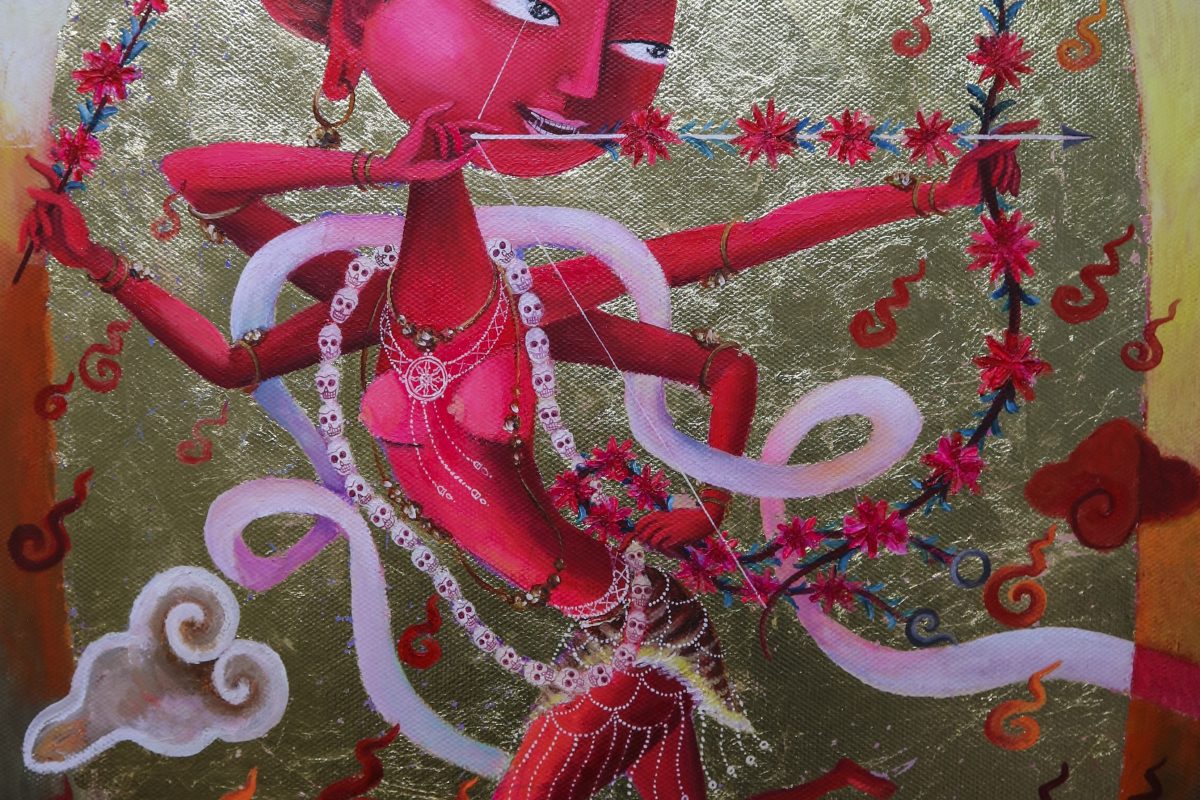
Featured Image Credit: “Kurukulle” by Soyalmaa Davaakhuu: https://dakiniasart.org/gallery/deities-dakinis/kurukulle/
[give_form id=”2915″]


